
AI-generated illustration
MODULE 3
Approach to Pitchside Injury Care
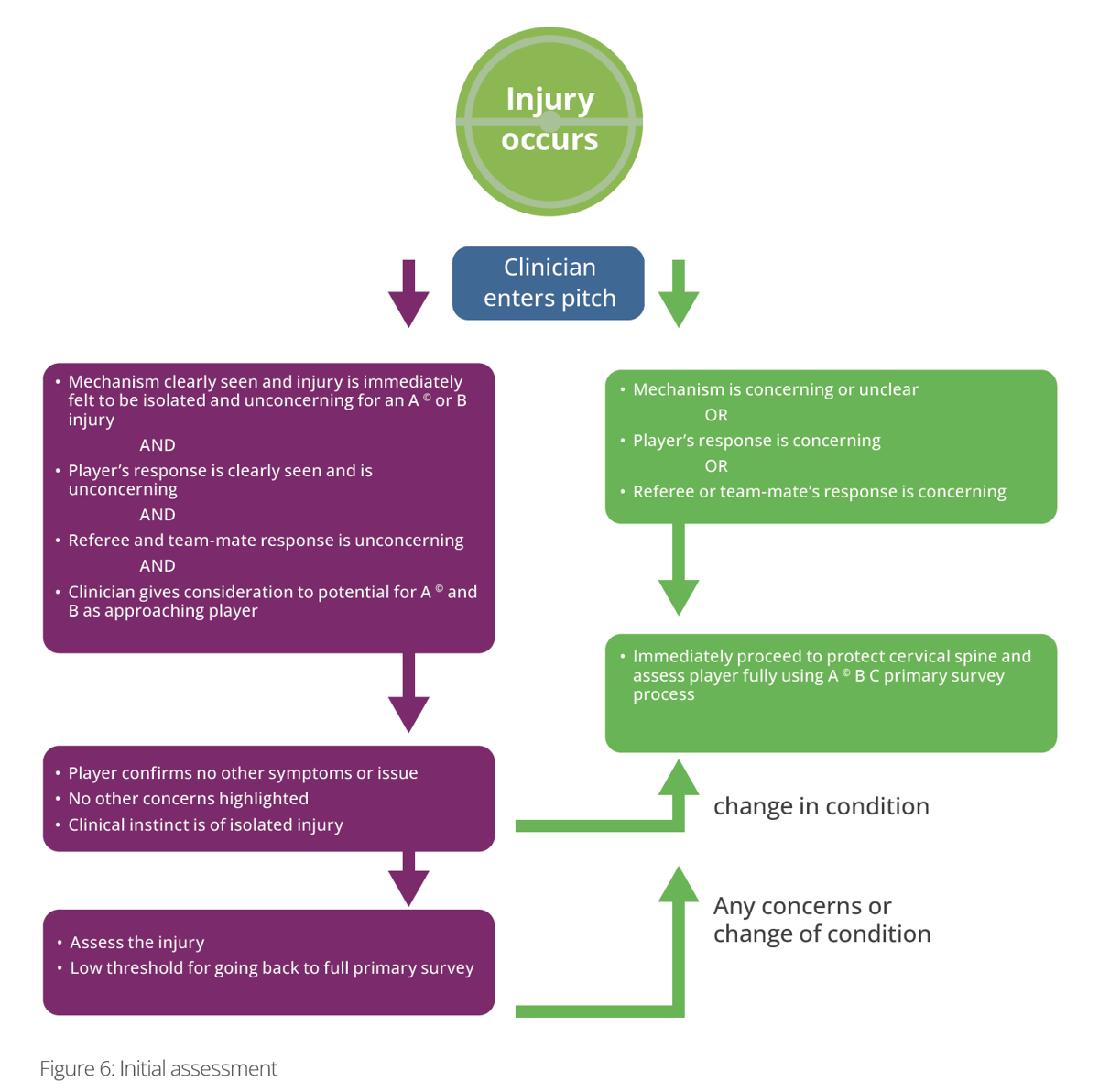
Focused primary survey vs complete primary survey
DEFINITION OF PRIMARY SURVEY
- A rapid, structured assessment.
- Performed to identify life- or limb-threatening injuries.
- When present, immediate intervention must be carried out.
- Designed to enable clinicians to perform evaluations efficiently.
PROTOCOL SELECTION — FOCUSED VS COMPLETE 1° SURVEY
Complete primary survey
Airway, C-spine, Breathing, Circulation, Disability, Exposure
- Mechanism of injury concerning or unclear, or player / referee / teammate responses raise clinical concern.
- Safer, minimises the risk of missing significant secondary injuries, and builds fluency through repeated practice.
Focused primary survey
Only the specifically suspected injured body part
- Mechanism clearly witnessed, injury isolated, responses unconcerning, player confirms no other symptoms, and clinical instinct supports an isolated injury.
Safety transition rule
If any concern arises or the player's condition changes, immediately switch to a complete primary survey.
PRE-SURVEY SCAN & SAFETY CHECKS
- 1 · PPE
- Don personal protective equipment before entering the pitch or assessing.
- 2 · Danger
- Check for immediate environmental hazards.
- 3 · 5-second rapid scan
- Signs of upper airway obstruction · central pulse · catastrophic haemorrhage.
A — AIRWAY & CERVICAL SPINE
- Look
- Facial trauma: wounds, swelling, haematoma, bleeding, deformity, foreign bodies.
- Listen
- Upper airway obstruction: stridor, gurgling, snoring, choking, hoarseness.
- Feel
- Facial tenderness, swelling or structural deformity.
- Quickest method
- Speak directly to the player to assess airway patency.
If obstruction is present:
- Manual opening: jaw thrust (preferred in trauma — no neck movement). Head-tilt/chin-lift is contraindicated with suspected trauma.
- Suction bleeding, secretions or vomitus while evaluating the gag reflex with the suction catheter.
- Adjuncts: OPA if the gag reflex is absent; consider an NPA if a gag reflex is present (best tolerated). NPA: relative contraindication with suspected base-of-skull fracture.
- High-flow oxygen via BVM or non-rebreather mask at 15 L/min — as soon as it arrives; do not wait for the survey to finish.
- Advanced: consider an i-gel LMA pitchside in cardiac arrest; intubation / RSI later at the medical base, ambulance or hospital.
FIFA: fix each problem before moving on — an obstruction is treated (jaw thrust, suction, adjunct) before assessing breathing. Never let players put fingers in a player's mouth. See the airway skill films on the Films page.
Cervical spine management:
- Initiate Manual In-Line Stabilisation (MILS) and palpate for cervical spine tenderness.
- Early collar application is not required if the player is conscious and alert — alert players naturally splint their neck.
- Apply a cervical collar if you are unable to clear the cervical spine — as part of extrication, not early in the survey (FIFA). Clearing can wait until the primary survey is done.
- Use the NSAID mnemonic to decide whether the spine can be cleared on-field.
- N
- Neurological deficit (numbness, weakness)
- S
- Spinal midline tenderness (on palpation)
- A
- Altered mental status (GCS < 15)
- I
- Intoxication
- D
- Distracting injury (severe enough to mask spinal pain)
Any NSAID feature present → the spine cannot be cleared; extricate in a collar. The player must also actively rotate the neck 45° laterally (the player moves, not the clinician), and the mechanism must not be concerning (e.g. axial load). Intoxication includes strong analgesics such as codeine. (NSAID here is a spinal-clearance mnemonic, not the drug class.)
FIFA: a player shouting or screaming has a patent airway. Signs of obstruction: gurgling, snoring, choking, stridor, cyanosis, no breathing effort — treat at once and give oxygen. Head-tilt/chin-lift only if there is no suspicion of trauma.
- FIFA — clearing the cervical spine (all needed)
- 1 No midline tenderness · 2 GCS 15 · 3 No distracting injury · 4 No neurology · 5 No concerning mechanism (e.g. fall onto the head, axial load) · 6 Active rotation of 45° to each side. The manual adds a seventh: no intoxication.
B — BREATHING
Red runs a full A–E assessment of an injured player: 1 observation, 2 hands on 3 places.
Watch on FIFA's website (opens in a new tab)Pitchside breathing assessment is limited — use a focused “hands-on 1, 2, 3” approach.
- 1 observation
- Respiratory rate — plus chest movement, deformity, flail segment, bruising, open wounds.
- 2 hands on 3 places
- 1. Neck · 2. Anterior chest wall · 3. Posterolateral chest wall.
- Assess
- Pain, surgical emphysema (crackling under the skin), swelling, asymmetry.
Listen as you approach: gurgling / stridor = upper airway; wheeze = lower airway; coughing is reassuring. Watch the trend. Auscultation has no value inside a noisy stadium. No respiratory effort → cardiac arrest protocol (skill module 2).
C — CIRCULATION & HAEMORRHAGE CONTROL
Check for active haemorrhage and evaluate CCTVR (Colour, Capillary refill, Temperature, Voluntary movement / pulse, Response).
- 1 observation
- Pulse — rate, volume and trend. Exercise tachycardia should settle; a worsening tachycardia is concerning.
- 2 hands · Abdomen
- Inspect and palpate all 4 quadrants.
- 2 hands · Pelvis
- Feel posterior → lateral → anterior. No downward pressure — DO NOT SPRING THE PELVIS.
- 2 hands · Long bones
- Femurs down to the ankles. A fractured femur can lose up to 1.5 L of blood.
- Direct pressure to control active bleeding — this takes priority in the survey.
- Splint suspected fractures (reduces bleeding and pain).
- Utilise a scoop stretcher to minimise movement during handling (~15° tilt vs a 90° log roll onto a board).
- Capillary refill centrally: press the sternum for 5 seconds; skin should pink up within 2 seconds. A normal CRT does not exclude bleeding.
- On-pitch BP has almost no value — measure it off the pitch with a properly fitted cuff.
- Radial pulse: it relates to blood pressure, but studies differ and no single pressure figure can be attached to it. An ABSENT radial pulse is extremely concerning — think cardiac arrest.
- Check blood glucose in any confused or collapsed player.
D — DISABILITY & NEUROLOGICAL STATUS
| AVPU (preferred) | GCS |
|---|---|
| Alert | 15 |
| Voice | 13 |
| Pain | 8 |
| Unresponsive | 3 |
Any score other than Alert mandates immediate removal from the field of play. Alert does NOT exclude concussion.
- Pupils: size and reactivity — a baseline. A unilateral fixed, dilated pupil with a falling GCS = emergency transfer to neurosurgery.
- Rapidly scan for unilateral neurological deficits.
- Ask about numbness or weakness.
- Observe limb movements and ask the player to move their limbs.
- Assess balance and gait when returning the player to standing, if appropriate.
FIFA “Hands On 1, 2, 3” for D: 1 observation = AVPU · 2 pupils (equal and reactive?) · 3 places — sensation and movement in the arms, upper legs and lower legs.
E — EXPOSURE & EXTRICATION
Complete necessary exposure and safely extricate the player from the pitch.
EXTRICATION KIT BELOW THE FEET, IN LINE WITH THE PLAYER
Set up below the feet (FIFA): basket in line with the player, 2–3 basket lengths from the feet; scoop out of the basket, extended and split, laid between the feet and the basket.
Source: FIFA Emergency Care Manual, Ch.2. The 5-second scan and the NSAID and CCTVR memory aids are practical additions, not from the manual. Study aid only — follow FIFA's current documents and your local protocol.