FIFA HEALTH & MEDICAL
Concussion assessment protocol (FOCUS)
Football-Specific Standardised On-Pitch Concussion Assessment Protocol.
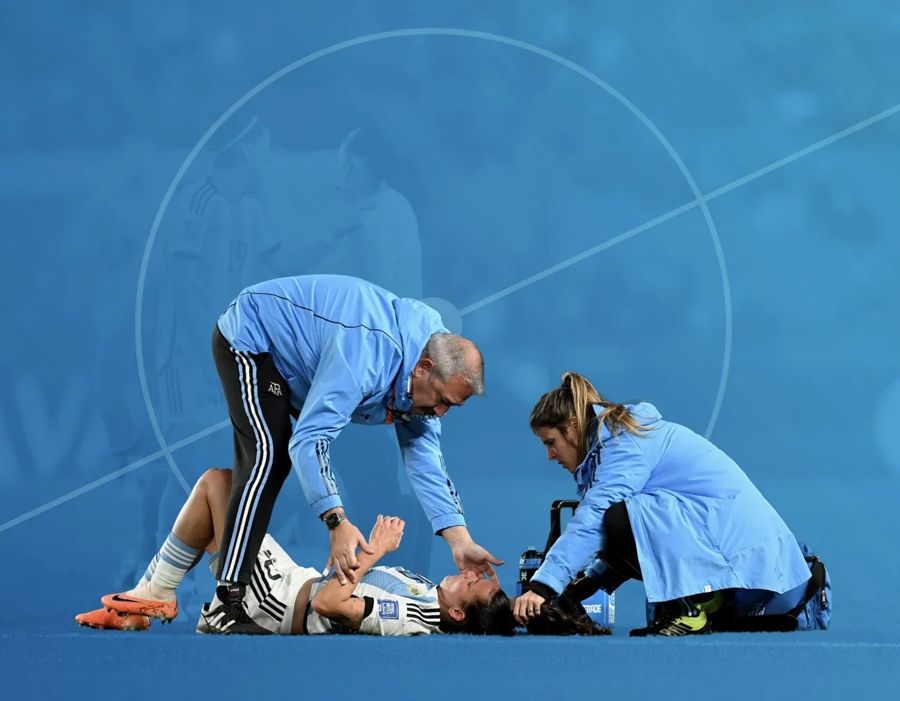
- A practical tool to identify players who must come off for a formal concussion assessment after a head impact.
- 11 domains, assessed from the touchline, on approaching the player, on the pitch, and back at the touchline.
- Built from a review of the scientific evidence with a global group of concussion clinicians and researchers.
Suspected concussion = remove from play immediately
Footballers who play on are more likely to have a prolonged recovery, worse performance and a risk of further injury. The on-pitch assessment is not there to diagnose concussion — only to decide whether any sign or symptom raises suspicion.
FIFA FOCUS VIDEO
FIFA's own film. Tap play — needs a connection.
FIFA's full overview of FOCUS, with examples of clinicians completing the assessment on the pitch.
Watch on FIFA's website (opens in a new tab)THE PROTOCOL — 11 DOMAINS
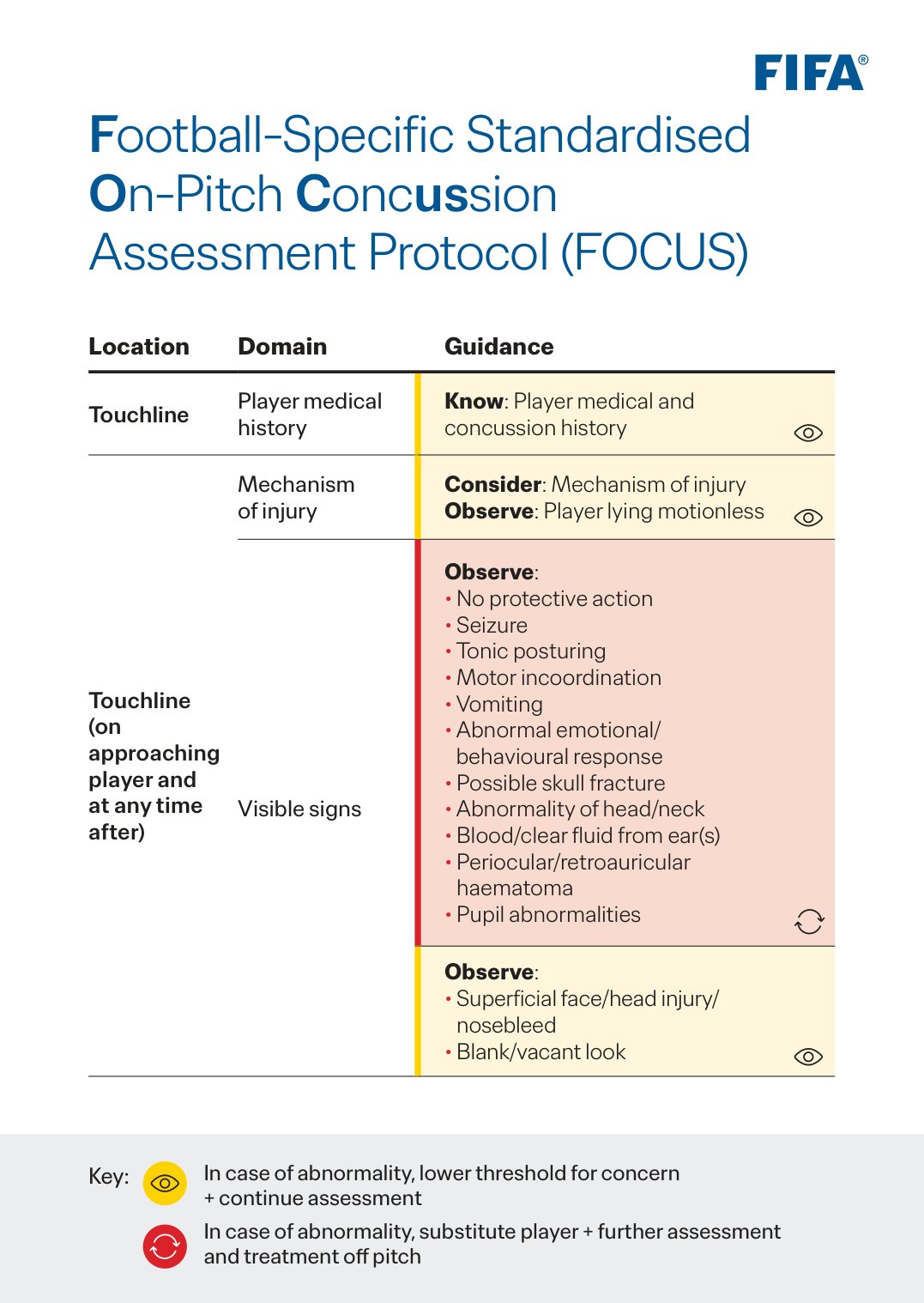
Abnormal: lower your threshold for concern and continue the assessment.
Abnormal: substitute the player; further assessment and treatment off the pitch.
- 1
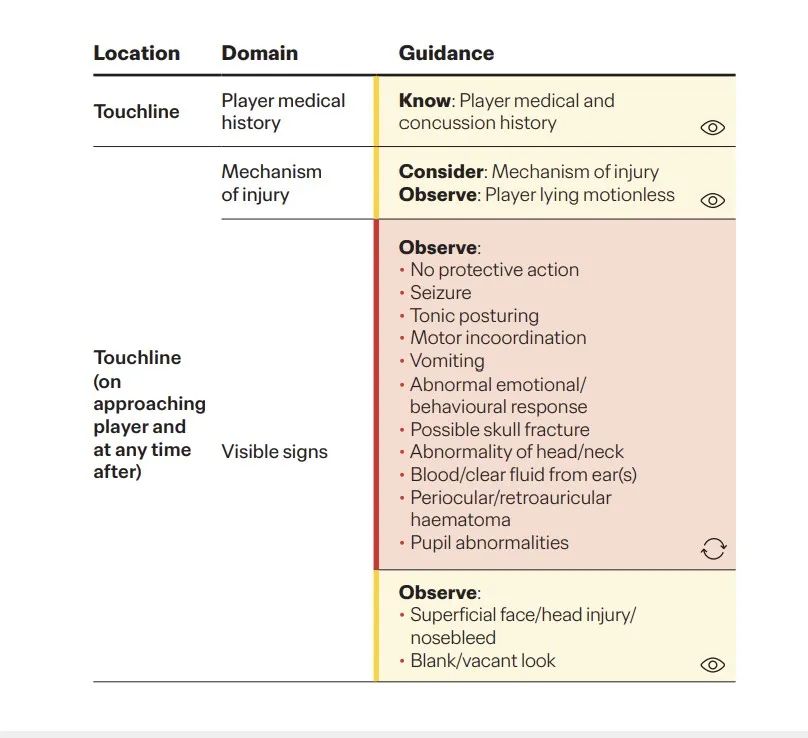
TOUCHLINE
Before any incident
Player medical history
Know: the player's medical and concussion history.
- 2
TOUCHLINE
On approaching the player, and at any time after
Mechanism of injury
Consider: the mechanism of injury. Observe: player lying motionless.
Visible signs
Observe:
- No protective action
- Seizure
- Tonic posturing
- Motor incoordination
- Vomiting
- Abnormal emotional / behavioural response
- Possible skull fracture
- Abnormality of head / neck
- Blood / clear fluid from ear(s)
- Periocular / retroauricular haematoma
- Pupil abnormalities
Visible signs
Observe:
- Superficial face / head injury / nosebleed
- Blank / vacant look
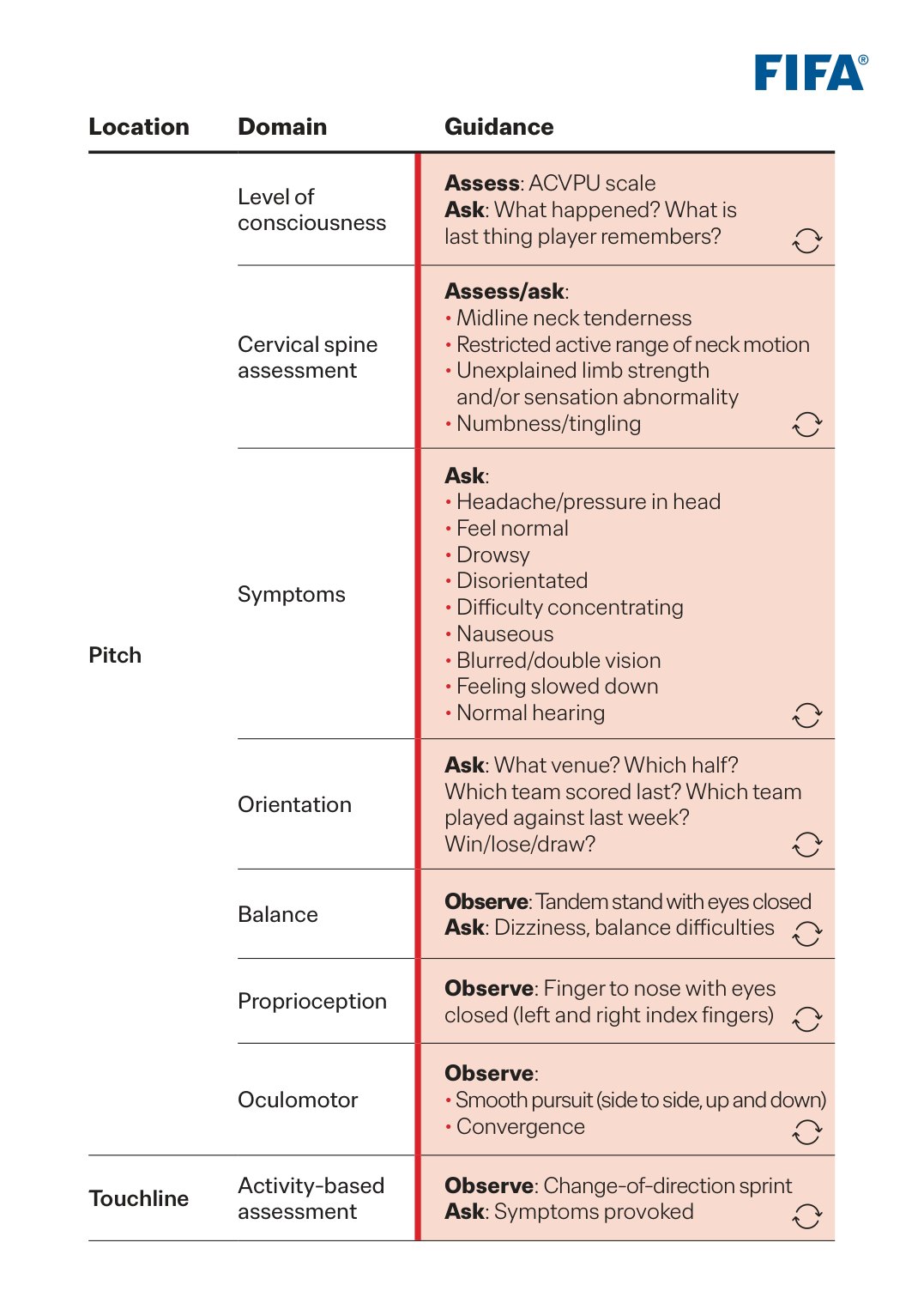
- 3
PITCH
With the player
Level of consciousness
Assess: ACVPU scale. Ask: What happened? What is the last thing you remember?
Cervical spine assessment
Assess / ask:
- Midline neck tenderness
- Restricted active range of neck motion
- Unexplained limb strength and / or sensation abnormality
- Numbness / tingling
Sit the player up
Ask the player to sit up — once the cervical spine assessment is done — then carry on with the symptoms.
Symptoms
Ask:
- Headache / pressure in head
- Feel normal
- Drowsy
- Disorientated
- Difficulty concentrating
- Nauseous
- Blurred / double vision
- Feeling slowed down
- Normal hearing
Orientation
Ask: What venue? Which half? Which team scored last? Which team did you play last week? Win / lose / draw?
Balance
Observe: tandem stand with eyes closed. Ask: dizziness, balance difficulties.
Proprioception
Observe: finger to nose with eyes closed (left and right index fingers).
Oculomotor
Observe:
- Smooth pursuit (side to side, up and down)
- Convergence
- 4
TOUCHLINE
After the on-pitch assessment
Activity-based assessment
Observe: change-of-direction sprint. Ask: symptoms provoked.
ACVPU = Alert, Confusion (new), Voice, Pain, Unresponsive. “Sit the player up” is a practical step added by this guide between FIFA's cervical spine and symptoms domains; it is not on FIFA's card.
FOCUS LANYARD CARD
FIFA's palm-sized card (April 2026). Tap a side to open it full size.
AFTER A SUSPECTED CONCUSSION
What FIFA's Concussion Protocol for Medical Staff (August 2024) asks for once a player has been removed. Concussion is a clinical diagnosis: a normal scan does not rule it out.
- No return the same day. A player with a suspected concussion does not go back on that day.
- Red flags — signs of a life-threatening problem or of bleeding in or around the brain: emergency management and consider immediate transfer to hospital.
- Yellow flags — any neurological or orthopaedic impairment, or the doctor is in doubt: remove from football and examine further, with a specialist if needed.
- CT scan on the day is recommended for any of: GCS below 13 (or below 15 after two hours), suspected skull fracture, more than one episode of vomiting, a seizure after the injury, loss of consciousness, persistent memory loss for events after the injury, or a focal neurological deficit.
- 72 hours of observation by the team doctor, with a daily check, because symptoms can appear late. Avoid medication that could mask or worsen symptoms until a more serious injury is ruled out.
- Before leaving the venue, and before any flight, re-examine for new or worsening signs.
GRADUATED RETURN TO FOOTBALL
- Symptom-limited daily activity, such as a short walk.
- Light aerobic exercise, up to about 70% of maximum heart rate.
- Football-specific exercises one-to-one (player and coach), with no contact and no heavy resistance.
- Non-contact training drills in a small group; only easy heading with a soft ball.
- Drills with controlled contact, and heading with a normal ball in a controlled setting.
- Full-contact team training, after medical clearance.
- Return to match play.
Each stage needs at least one session and lasts at least 24 hours. If symptoms return, rest until they settle (at least 24 hours) and go back to the last symptom-free stage. The doctor re-examines the player before stage 1 and again before stage 6, and clearance rests on medical grounds only. Be more cautious with younger players and after repeated concussions.
Read FIFA's Concussion Protocol for Medical Staff (PDF, on FIFA's website)FIFA RESOURCES
 FOCUS — full resource documentThe most comprehensive guide to the on-pitch assessment using FOCUS.
 FOCUS — pocket leafletA one-page reference guide to print.
 FOCUS — lanyard / pocket guideA palm-sized card to take onto the pitch.
- FOCUS lanyard — print version, April 2026PDF
- FOCUS — frequently asked questionsPDF
- FIFA Concussion Protocol for Medical Staff (elite)PDF
- FIFA Concussion Protocol for Grassroots Football (non-elite)PDF
- FOCUS — international consensus recommendations (JAMA Neurology)Paper
- Concussion: Suspect and Protect (FIFA campaign)Web
From FIFA's FOCUS page and the FOCUS lanyard (April 2026). Film, card and documents © FIFA.