PITCHSIDE EMERGENCY CARE

Skill modules · study notes

All skill modules
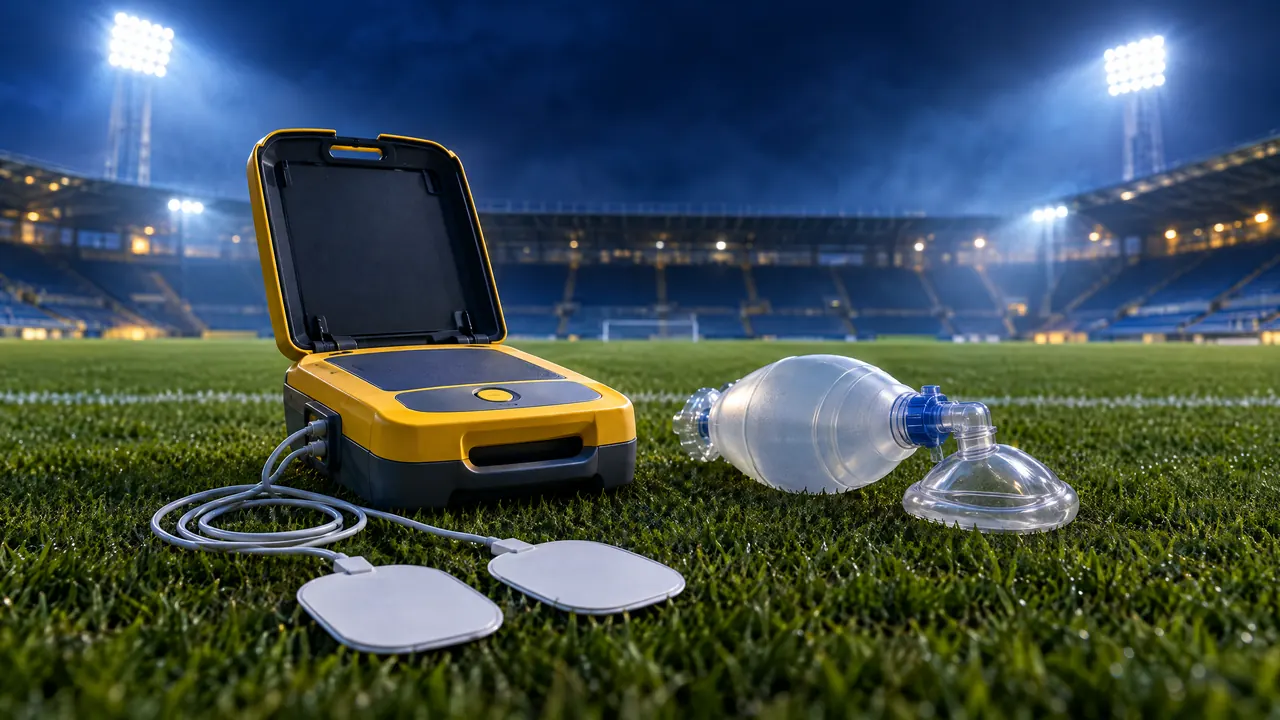
An AED with its pads and a bag-valve mask on the grass of a floodlit pitch

AI-generated illustration

MODULE 2

Approach to Pitchside Cardiac Arrest

Part 1 — BLS + AED · Part 2 — 10-second stop and start for ambulance transfer

TEAM MEMBER ROLES & EQUIPMENT

Team leader — brings: Phone or radio, and the completed PEAP sheet with the contact numbers.

BLACK
  • Player's LEFT side, level with the chest (PEAP black mark). Hands-off where possible.

Head · airway & cervical spine — brings: Laryngeal mask airway (i-gel) and bag-valve with reservoir.

ORANGE
  • At the player's HEAD (PEAP orange mark). Hands stay on the head until the neck is cleared or fully immobilised.

Chest — brings: Nothing. First hands on the player.

RED
  • Player's RIGHT side, level with the chest (PEAP red mark).

Pelvis — brings: Oxygen cylinder.

BLUE
  • Player's RIGHT side, level with the pelvis (PEAP blue mark), next to Red.

Legs — brings: Scoop stretcher and splints.

WHITE
  • Player's RIGHT side, level with the lower legs (PEAP white mark), next to Blue.

Equipment · bag & AED — brings: FIFA Emergency Care Bag and AED.

GREEN
  • At the HEAD on the player's LEFT, with the FIFA bag and AED open beside you (PEAP green mark).

STEP BY STEP

Sudden Cardiac Arrest — FIFA Medical Set PieceFIFA Medical · 3:41Open — Watch on FIFA's website (opens in a new tab)

FIFA's own film of the colour-coded Medical Set Piece: recognition, CPR, AED, airway and the role of each team member on the pitch.

Watch on FIFA's website (opens in a new tab)

1 · Recognise (At once)

REDBLACK
  • Non-contact collapse = sudden cardiac arrest. Enter at once — do not wait for the ball to go out of play.
  • Unresponsive to voice or touch. Gasping, slow breathing or slow seizure-like movements are cardiac arrest, not a fit.
  • Red checks for signs of life: breathing and carotid pulse together, no more than 10 seconds.
  • Black ensures the ambulance is called.

2 · Chest compressions (No delay)

RED
  • Red starts compressions in the middle of the chest: 5–6 cm deep, 100–120 per minute, full recoil.
  • 30 compressions to 2 breaths until the i-gel is in.
  • Airway and breathing are not the first priority in adult cardiac arrest: compressions and the AED come first.

3 · AED and shock (The moment it arrives)

GREENREDBLUE
  • Green applies the AED as soon as it arrives — do not wait for the current 30-count. Red keeps compressing while the pads go on.
  • Analysis: hands off. Shock advised: Green checks that everyone is clear and that oxygen is removed (it can stay on a closed loop such as an i-gel), then shocks.
  • After the shock: no pulse check. Restart compressions at once.
  • Rhythm check every 2 minutes; swap the person compressing.

4 · Airway and oxygen (Once CPR + AED are running)

ORANGEBLUE
  • Orange inserts the i-gel (FIFA's adjunct of choice in cardiac arrest) and attaches the bag valve.
  • Blue connects oxygen at 15 L/min to the bag reservoir.
  • With the i-gel in: continuous compressions, one breath every 10th compression (about 10 per minute). If it leaks: 30:2.
  • No i-gel: OPA or NPA with a face mask is a two-person technique at 30:2.

5 · Prepare the transfer (Planned before kick-off)

BLACKORANGEWHITEBLUE
  • FIFA's protocol: after the third shock and medications, the team leader considers extricating the player.
  • Best: the ambulance comes onto the field to the player. Agree this before the match.
  • Otherwise: log roll on Orange's count — Red chest, Blue pelvis, White legs — onto a long spinal board (a scoop can also be used).
  • Strap the player, the board and the AED together as one unit.
  • A mechanical chest-compression device, where available and the team is trained on it, is fitted before the move so compressions are barely interrupted.

6 · Stop-and-start carry (≤ 10 s each)

BLACKGREEN
  • On Black's command, lift and carry for no more than 10 seconds — Green counts out loud.
  • Then put the player down and give at least 2 minutes of compressions before the next carry.
  • Repeat until the player is inside the ambulance. Continue CPR en route.
  • Destination: a hospital with 24/7 coronary angiography, agreed before the match.
  • ALS if trained: adrenaline 1 mg IV after the 3rd shock (as soon as possible if non-shockable), then every 3–5 min; amiodarone 300 mg after the 3rd shock, 150 mg after the 5th.

AIRWAY & VENTILATION IN ARREST

FIFA — 3 keys to survival
1 Recognise SCA · 2 Early good-quality compressions · 3 Early, safe defibrillation.
Pads
Anterolateral, lateral pad in the mid-axillary line — keep compressing while the pads go on.
  • i-gel is FIFA's adjunct of choice: one person holds it and squeezes the bag.
  • Bag with reservoir on oxygen at 15 L/min — better than a face mask + Guedel (two-person, poorer seal).
  • Continuous compressions, one breath every 10th compression. Leak → pause for 30:2.
  • Let the bag refill after each squeeze. Watch for symmetrical chest rise.
  • No i-gel: use the adjunct you know best (OPA or NPA) with a face mask.

Oxygen at the shock

FIFA's 2025 on-field protocol: remove oxygen before the shock, unless it is on a closed loop such as an LMA (i-gel) — then it can stay connected. With a face mask only, take the mask and oxygen away for the shock and replace them straight after. The 2022 manual's older advice was to turn the oxygen off or disconnect it.

ADVANCED LIFE SUPPORT (IF TRAINED)

RhythmDrug
Shockable (VF / pVT)Adrenaline 1 mg IV after the 3rd shock, then every 3–5 min. Amiodarone 300 mg after the 3rd shock; 150 mg after the 5th.
Non-shockable (asystole / PEA)Adrenaline 1 mg IV as soon as possible, then every 3–5 min.

Good compressions and early defibrillation matter most — do not let ALS distract from them. Reversible causes on the pitch: hypoxia, hypovolaemia, hypo/hyperthermia, tension pneumothorax.

Every minute counts

For every minute without return of circulation, the chance of a good outcome falls by up to 10% (FIFA on-field protocols).

Moving the player: FIFA's protocol is that after the third shock and medications, extrication is considered at the team leader's discretion. A mechanical chest-compression device, where available and the team is trained on it, is fitted first so compressions are barely interrupted. Without one, use the 10-second stop-and-start carry. An ambulance coming onto the field to the player is always preferable.

Source: FIFA on-field protocols (Version 3, March 2025) and the FIFA Emergency Care Manual, Ch.3. Where the two differ, the newer protocols are followed. Study aid only — follow FIFA's current documents and your local protocol.