
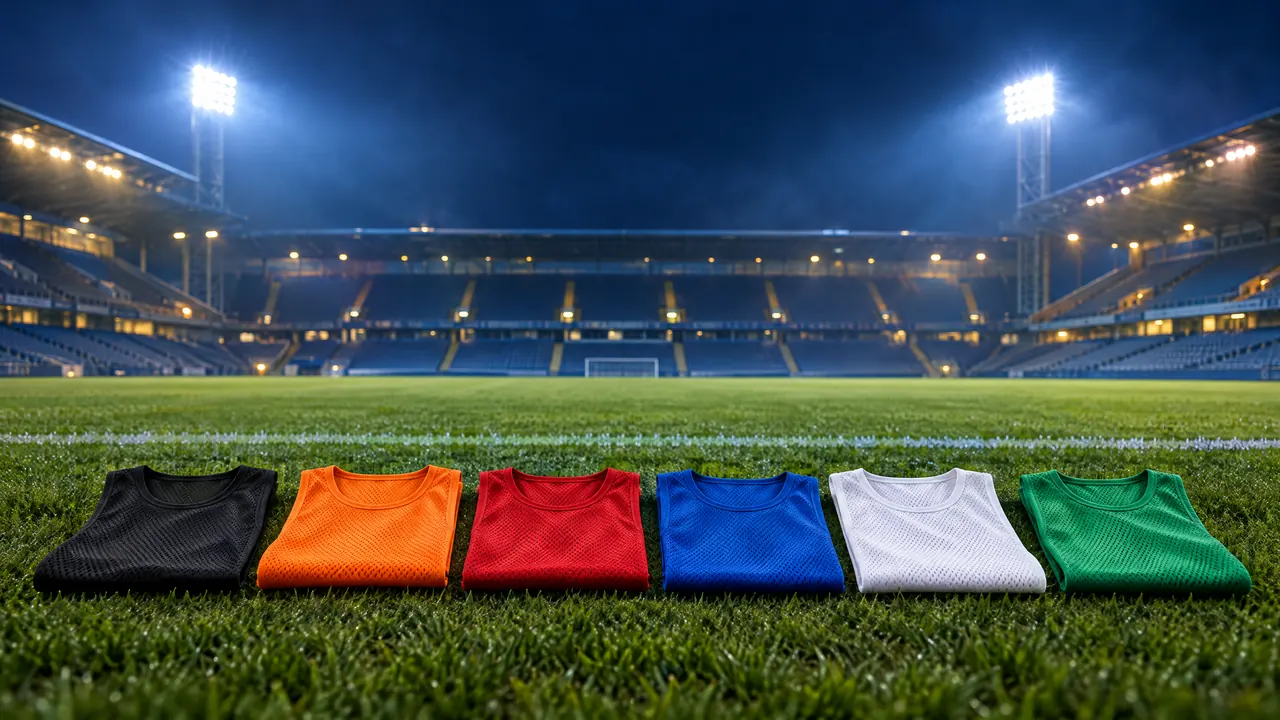
AI-generated illustration
MODULE 1
FIFA Pre-Match Emergency Action Plan (PEAP)
Roles & responsibilities of team members, positioning & team ergonomics
THE MEDICAL SET PIECE
A pitchside emergency should be rehearsed before kickoff: clear plan, clear roles, correct positioning, ready equipment and closed-loop communication.
- The team doctor enters first, followed by the rest of the medical team.
- Team leader (Black) — leads, ideally hands-off.
- Around the player: Orange (head), Red (chest), Blue (pelvis), White (legs) and Green (bag and AED).
BEFORE KICKOFF: 5 KEY PEAP COMPONENTS
M — Meeting
Who is involved?
- Home team doctor
- Visiting team doctor
- Venue medical officer
- Pitchside paramedics
C — Contacts
Who do we call and where do we go?
- Emergency numbers
- Access / egress gates
- Ambulance location
- Receiving hospital
R — Roles & positioning
Who does what and where?
- Assign the team leader and the five colour roles
- Brief any extrication team the venue provides
- Confirm positions
- Brief the team
E — Equipment
Is everything ready?
- Emergency care bag
- AED + pads
- Oxygen + BVM
- Scoop / spinal board / basket + straps
T — Training
Have we rehearsed?
- Rehearse the critical scenarios before the event
- Sudden cardiac arrest · cervical spine injury · trauma
- Every colour practises its own role, with the real equipment
- Debrief, then fix the gaps
M-CRET = Meet → Call → Position → Check → Train
- FIFA — before the tournament
- The whole medical team trains in the FIFA set piece with the FIFA Match Doctor (usually Black, the team leader) 5–7 days before the first match, on the standard FIFA equipment.
- FIFA — on matchday
- Between 2 hours and 1 hour before kick-off the team runs moulages (simulations) of the most critical scenarios, led by the FIFA Match Doctor.
- FIFA — everywhere
- Use and rehearse the PEAP in all football settings — training sessions as well as matches — adapted to the site and the expertise available.
- How often
- Practise the emergency plan at least once a year with everyone likely to respond, and review it briefly with the home and visiting medical staff before each competition.
- How to rehearse
- Hands-on and scenario-based, at different places in the venue: sudden cardiac arrest, head and neck injury, heat stroke and limb injuries. Record when, where, who took part and which scenarios.
- After a real emergency
- Debrief with everyone involved and use it to improve the plan.
- Why it matters
- Aim for the first shock within 3 minutes of collapse. In one US study, 89% of school athletes survived a cardiac arrest when CPR and defibrillation were prompt — and survival was higher with an AED already on site.
Sources: FIFA Medical Set Piece — Protocols for on-field interventions (2025); consensus on sudden cardiac arrest on the field of play (Br J Sports Med, 2017); NATA position statement on emergency action plans in sport (J Athl Train, 2024).
GOLDEN RULE: NON-CONTACT COLLAPSE
Presume sudden cardiac arrest (SCA) until proven otherwise
ENTER IMMEDIATELY → ASSESS → START CPR → APPLY AED WITHIN 30 SECONDS. Do not delay CPR / defibrillation for C-spine or fracture assessment in a non-contact collapse.
MEDICAL TEAM MEMBERS
| Role | Position | Main responsibility |
|---|---|---|
| Team leader (Black) | Player's left, level with the chest | Hands off. Overall command, CPR/AED flow, calls any lift, ambulance and referee liaison. |
| Head (Orange) | At the head | Manual in-line stabilisation and airway; i-gel and bag in cardiac arrest; commands the log roll. |
| Chest (Red) | Player's right, level with the chest | A-c-B-C-D-E assessment and treatment; chest compressions 100–120/min with full recoil. |
| Pelvis (Blue) | Player's right, level with the pelvis | Oxygen at 15 L/min; takes the PELVIS in the log roll; takes over compressions at 2 minutes. |
| Legs (White) | Player's right, level with the lower legs | Brings the scoop and splints; takes the LEGS in the log roll; assists as directed. |
| Equipment (Green) | At the head, player's left | FIFA bag and AED; hands equipment to Red; applies the AED and checks all clear before a shock. |
- Six roles
- Black, Orange, Red, Green, Blue and White — the colours on FIFA's PEAP poster.
- Smaller teams
- One person can cover more than one role if they are able to. Every role still has to be filled.
- Extrication team
- The current FIFA PEAP shows six roles: Black, Orange, Red, Green, Blue and White. Earlier versions also marked a separate extrication team in yellow, usually four first aiders provided by the stadium. Some venues and teaching centres still use one. If yours does, include them in the pre-match plan: they wait beside the scoop and basket, facing the player, and join only when the team leader calls them — to help with a log roll or to carry.
FIFA ECM: the Chest member should be one of the most experienced — they lead if no one else can. Pelvis and Legs need no medical skills but must be trained in the log roll. First aiders and paramedics only help if they are part of the plan.
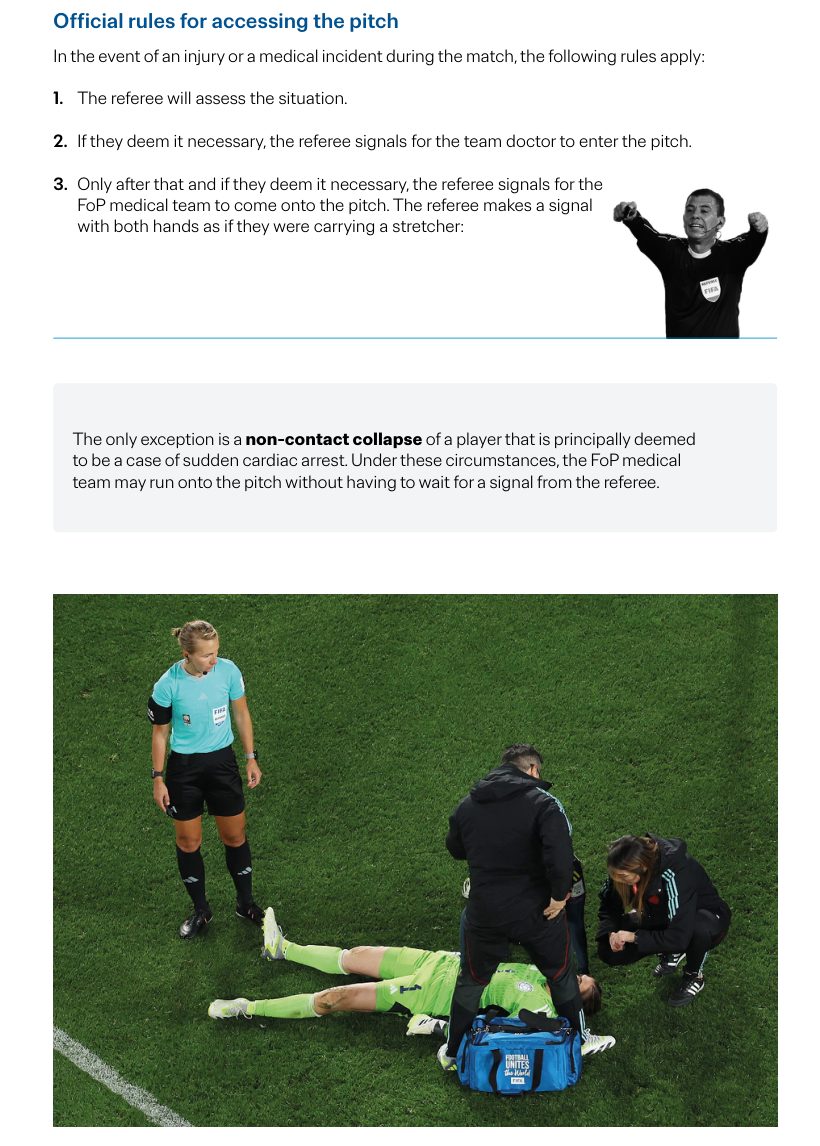
ENTERING THE PITCH (FIFA RULES)
- The referee assesses the incident.
- If needed, the referee signals the team doctor onto the pitch.
- Only then, if needed, the referee calls the medical team — both hands held as if carrying a stretcher.
Exception: non-contact collapse
A player who collapses without contact is treated as sudden cardiac arrest — the medical team runs on without waiting for the referee's signal.
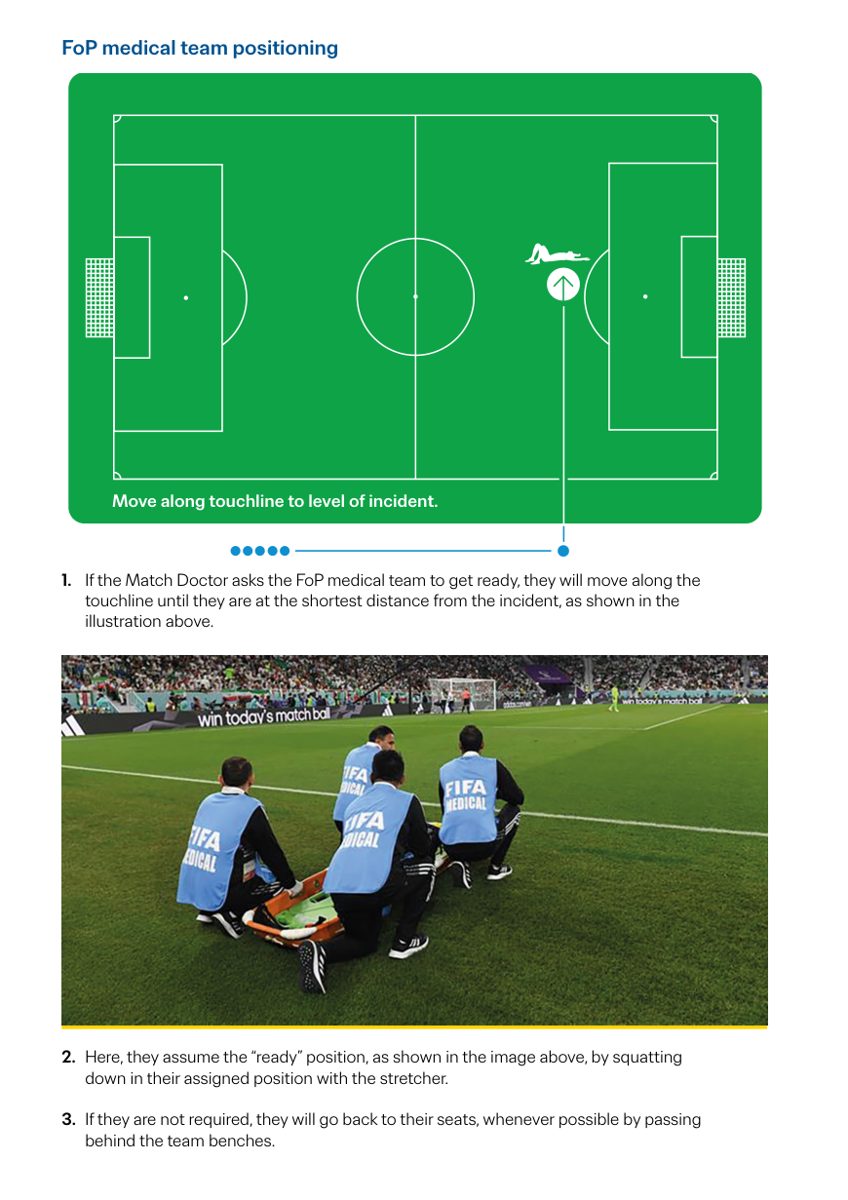
SIDELINE POSITION AND READY POSITION
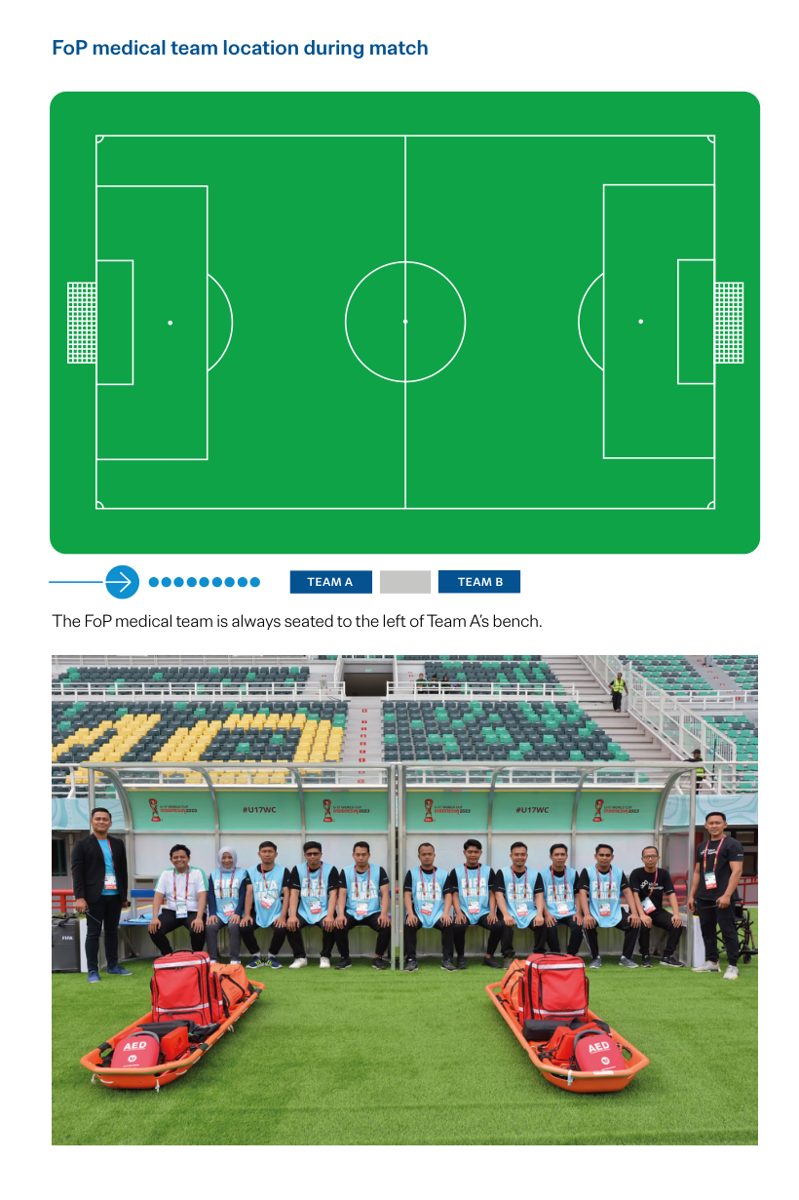
- At FIFA matches the medical team sits to the left of Team A's bench, with the extrication kit set up beside the bench.
- The team leader may call the team into the “ready” position.
- Ready: move along the touchline to the point closest to the incident and squat in your assigned position with the stretcher.
- Not needed: return to your seats, passing behind the team benches where possible.
- Medical team at FIFA matches
- 8–9 members: one emergency physician experienced in out-of-hospital care plus paramedics / health professionals doing BLS and ALS, with 2–3 reserves. The same team works every match at a venue.
- Training
- The whole team trains in the FIFA set piece with the FIFA Match Doctor 5–7 days before the first match, on the standard FIFA equipment.
- FIFA Match Doctor
- Usually Black, the team leader. Sits with and leads the team, reviews injury mechanisms on a replay device (often with a remote injury spotter), makes their own assessment, calls the ready position, and enters for potentially serious injury or concussion — then directs when the team comes on with the equipment.
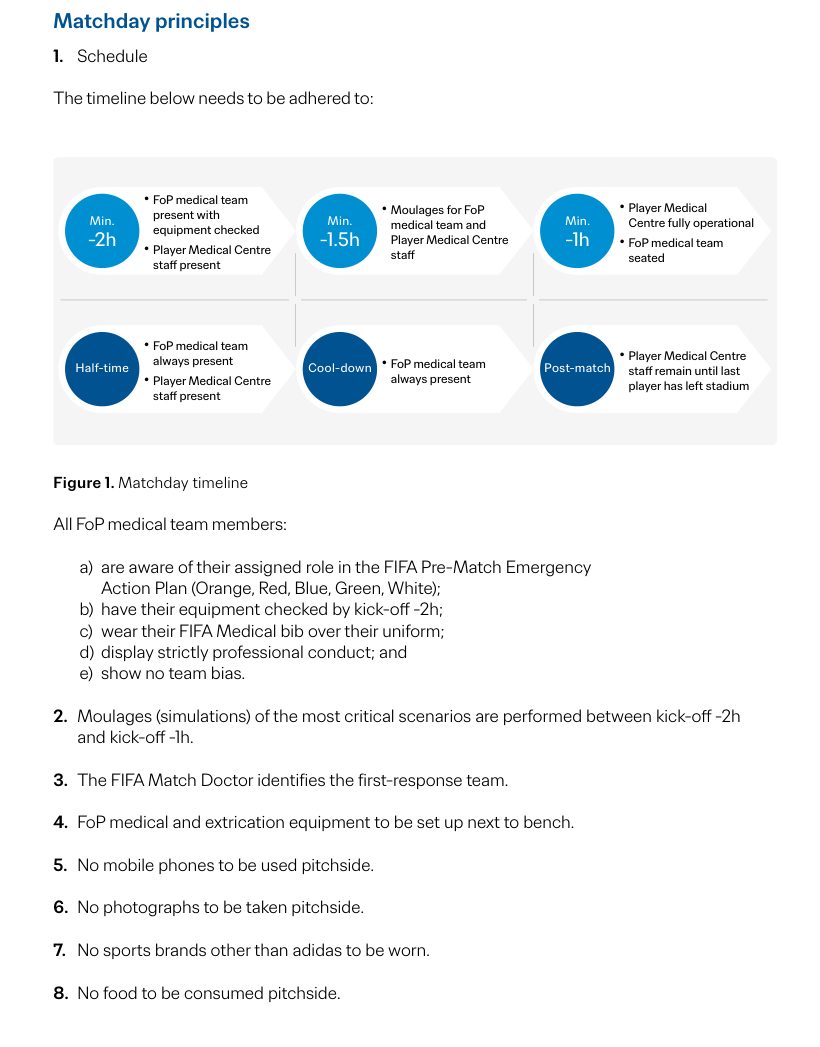
MATCHDAY PRINCIPLES
- Kick-off −2 h
- Team present, equipment checked; player medical centre staffed.
- −2 h to −1 h
- Moulages (simulations) of the most critical scenarios, led by the FIFA Match Doctor.
- Half-time · cool-down
- Medical team always present.
- Post-match
- Medical centre staff stay until the last player has left the stadium.
- Everyone knows their PEAP colour, wears their bib and shows no team bias.
- Equipment set up next to the bench; no phones, photos or food pitchside.
FIFA SKILL ZONE: SIDELINE AND SET-UP
FIFA's own films of the first seconds of the set piece: where the team waits, how it enters, and how the kit is laid out around the player.
Where the medical team waits and moves along the touchline so it can enter the pitch at once.
Watch on FIFA's website (opens in a new tab)How the team lays out the bag, oxygen and extrication kit around the player as per the FIFA Medical Set Piece.
Watch on FIFA's website (opens in a new tab)PITCHSIDE POSITIONING & TEAM ERGONOMICS
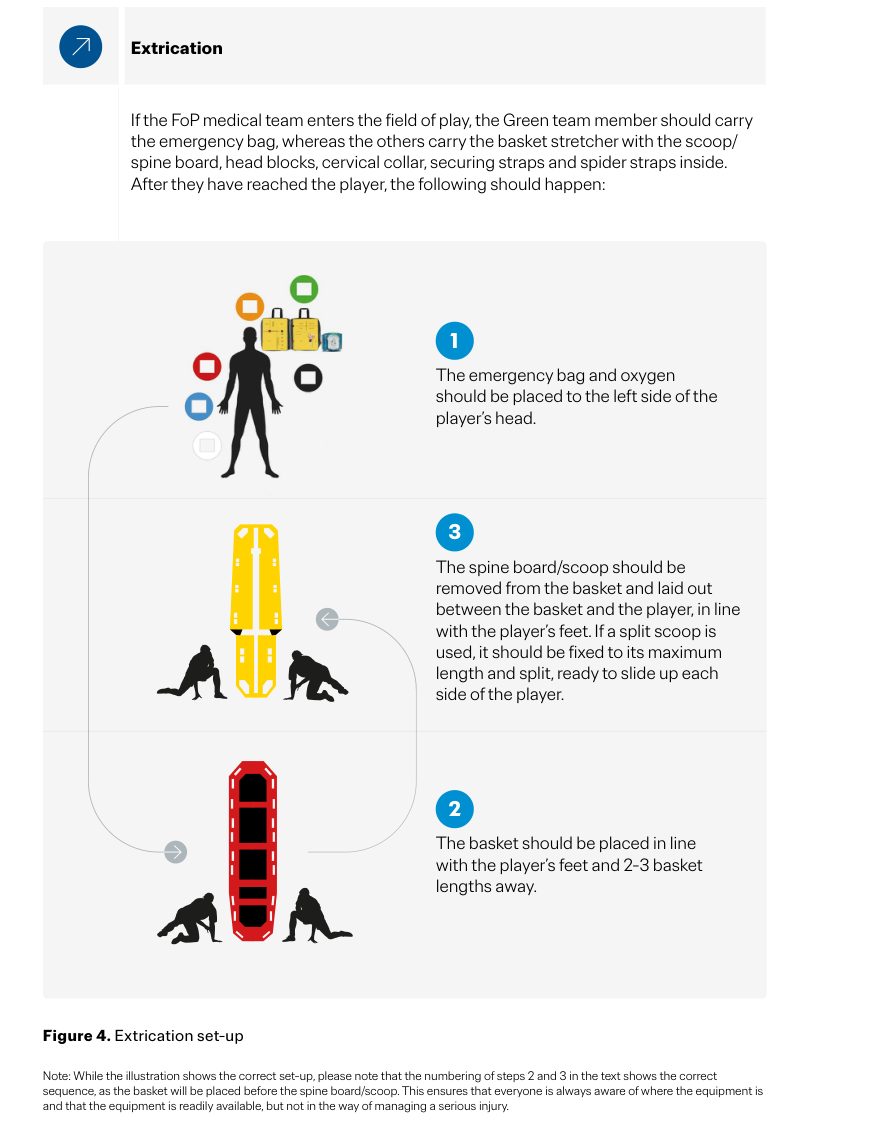
Extrication kit: below the feet, in line with the player. Basket 2–3 basket lengths from the feet; scoop taken out, opened and split, laid between the feet and the basket.
- Equipment zone
- AED + O2 + emergency care bag at the player's head / left side.
- Extrication zone
- Below the player's feet, in line with the body: basket 2–3 basket lengths from the feet, scoop opened out and split between the feet and the basket. Kept back until required.
- Team leader
- Hands-off, with a full view of the whole scene. Keep the working area clean and uncluttered.
EXTRICATION SET PIECE
PREPARE → TILT → SCOOP → STRAP → BASKET → GO
- Orange (the head) commands a gentle 15–20 degree tilt.
- Reconnect the scoop head first, then feet.
- Strap: Chest → Pelvis → Legs → Head.
- Medical kit (FIFA)
- FIFA bag + oxygen to one side of the head; one person hands out equipment.
- Extrication kit (FIFA)
- Basket in line with the feet, 2–3 basket lengths away. Scoop out of the basket, extended and split between basket and player.
- Extrication team, if the venue has one
- Stand or kneel beside the scoop and basket, facing the player, and wait for the team leader. One stays free to pass the scoop and slide the basket in.
The set piece above is for trauma. For a cardiac arrest in progress the player is moved on a long spinal board (a scoop can also be used) with the AED strapped on as one unit — see the cardiac arrest module.
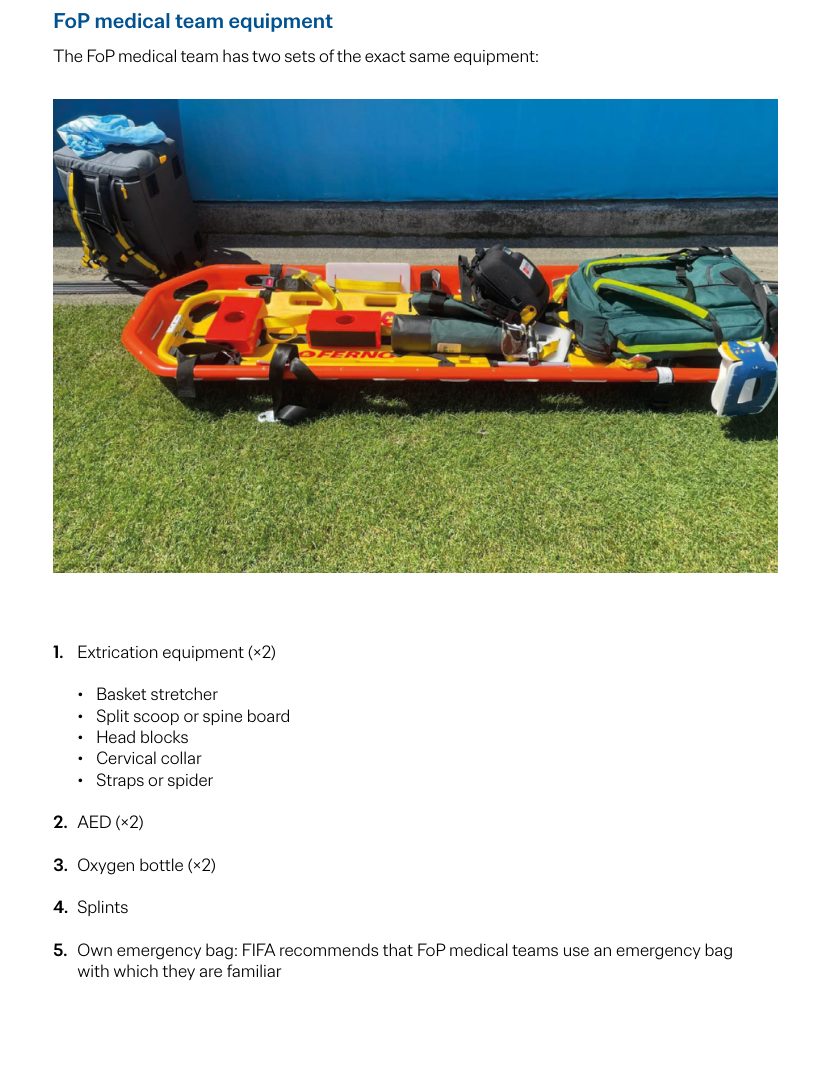
- FIFA team kit (two identical sets): basket stretcher, split scoop or spine board, head blocks, cervical collar, straps or spider; AED; oxygen bottle; splints; an emergency bag the team knows well.
- Entering: Green carries the emergency bag; the others carry the basket with the scoop / board, head blocks, collar and straps inside.
CLOSED-LOOP COMMUNICATION
NAME → COMMAND → REPEAT → CONFIRM
Example — Team leader: “Green, apply the AED.” Green: “Applying AED.” Green: “AED attached.”
POCKET SUMMARY
- Before match
- M-CRET: Meet – Call – Position – Check – Train
- Non-contact collapse
- SCA → CPR → AED the moment it arrives. The team leader calls any lift.
- Leadership
- Hands off – eyes up. Command and confirm.
- Extrication (trauma)
- Orange commands. Tilt – Scoop – Strap – Basket.
Source: FIFA Emergency Care Manual, Ch.1; FIFA's PEAP poster; and FIFA's protocols for on-field interventions during matches (tournament team size, timings and bench position). Study aid only — follow FIFA's current documents and your local protocol.