
FIFA HEALTH & MEDICAL
Pitchside emergency care
FIFA's Skill Zone films, set-piece protocols, role cards and the emergency care bag.
- Every collapse or injury is assessed the same structured way — the medical version of a “set piece”.
- The same framework applies in training, warm-up and matches.
- FIFA's Emergency Care Manual holds the full protocols (the main source for this guide).
FIFA SKILL ZONE — 5 FILMS
Each film opens on FIFA's website.
- Moving along the sideline and ready positionFIFA Skill Zone · 1:22Open — Watch on FIFA's website (opens in a new tab)
Where the medical team waits and moves along the touchline so it can enter the pitch at once.
Watch on FIFA's website (opens in a new tab) - Setting up of equipmentFIFA Skill Zone · 1:28Open — Watch on FIFA's website (opens in a new tab)
How the team lays out the bag, oxygen and extrication kit around the player as per the FIFA Medical Set Piece.
Watch on FIFA's website (opens in a new tab) - Hands On 1, 2, 3FIFA Skill Zone · 4:02Open — Watch on FIFA's website (opens in a new tab)
Red runs a full A–E assessment of an injured player: 1 observation, 2 hands on 3 places.
Watch on FIFA's website (opens in a new tab) - Cervical spine injuryFIFA Skill Zone · 8:09Open — Watch on FIFA's website (opens in a new tab)
The full colour-coded set piece for a suspected neck injury: MILS, assessment, collar, log roll or scoop and extrication.
Watch on FIFA's website (opens in a new tab) - Lower limb injuryFIFA Skill Zone · 3:03Open — Watch on FIFA's website (opens in a new tab)
Assessing and splinting a lower-limb injury on the pitch before extrication.
Watch on FIFA's website (opens in a new tab)
PEAP & ROLE CARDS
The Pre-Match Emergency Action Plan links each key intervention to a pre-assigned colour role, so the team prepares proactively instead of reacting. Use and rehearse it in all football settings — training and matches — adapted to the site and the expertise available.
FIFA's role cards give each member one colour and one set of tasks. Ideally one card per person; in a small team one person may hold more than one role if competent to do both.
Open your colour — each role page now shows FIFA's official card →THE FIFA MEDICAL SET PIECE
A rehearsed, scripted response: every member has one clearly defined role, stays task-focused and does not interfere with anyone else's. FIFA's toolkit gives colour-coded protocols for on-field interventions, sudden cardiac arrest and cervical spine injury — the colours match the PEAP roles.
Cervical spine injury — set piece by colour →Concussion assessment (FOCUS) →PROTOCOLS FOR ON-FIELD INTERVENTIONS
FIFA Medical Set Piece booklet, version 3 (March 2025) — used at FIFA World Cups.
- Team: 8–9 members — one emergency physician plus paramedics / health professionals, trained in the set piece by the FIFA Match Doctor (usually Black, the team leader) 5–7 days before the first match.
- Matchday: present and kit checked by kick-off −2 h; moulages between −2 h and −1 h; always present at half-time and cool-down.
- Entering the pitch: only on the referee's stretcher signal — except a non-contact collapse, when the team runs on at once.
- Ready position: move along the touchline level with the incident and squat with the stretcher.
- Kit: two identical sets — basket, scoop or spine board, head blocks, collar, straps; AED; oxygen; splints.
- SCA: the chance of a good outcome falls by up to 10% per minute. After the third shock and medications the team leader considers extrication, with a mechanical CPR device fitted first where available; without one, use the 10-second stop-and-start carry.
- Neck injury: collar → log roll onto the scoop → straps (centre strap on the sternum) → head blocks → tape → release MILS → basket, 6 people.
- Extremity fracture: full A–E first; hands above and below; analgesia; clean and dress wounds; splint and recheck.
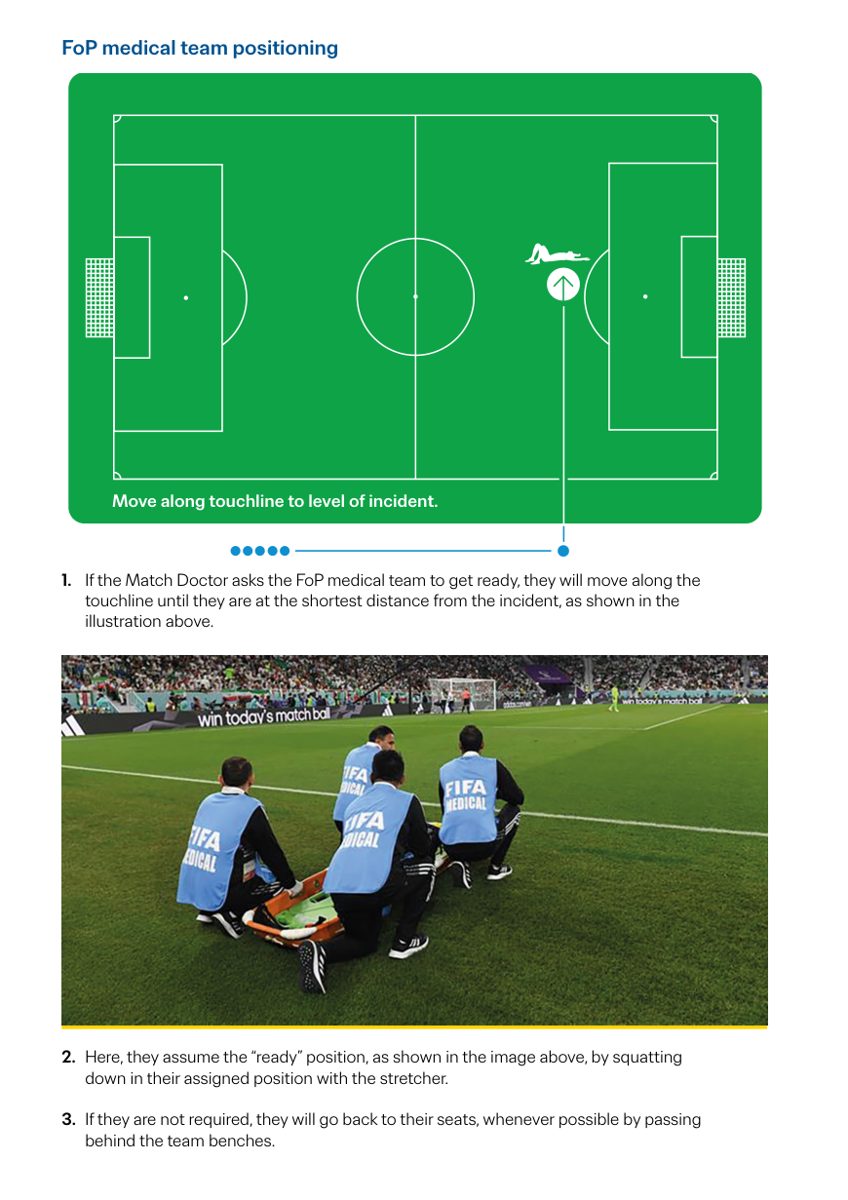
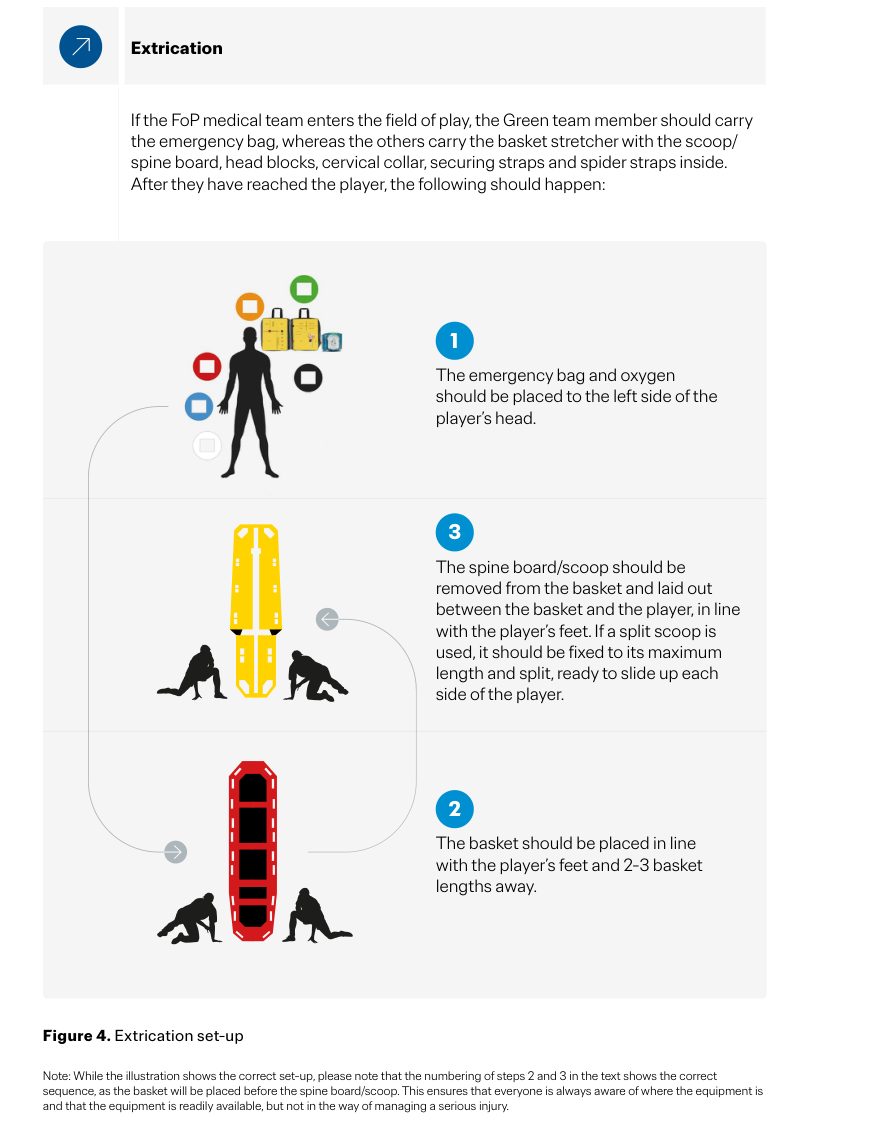
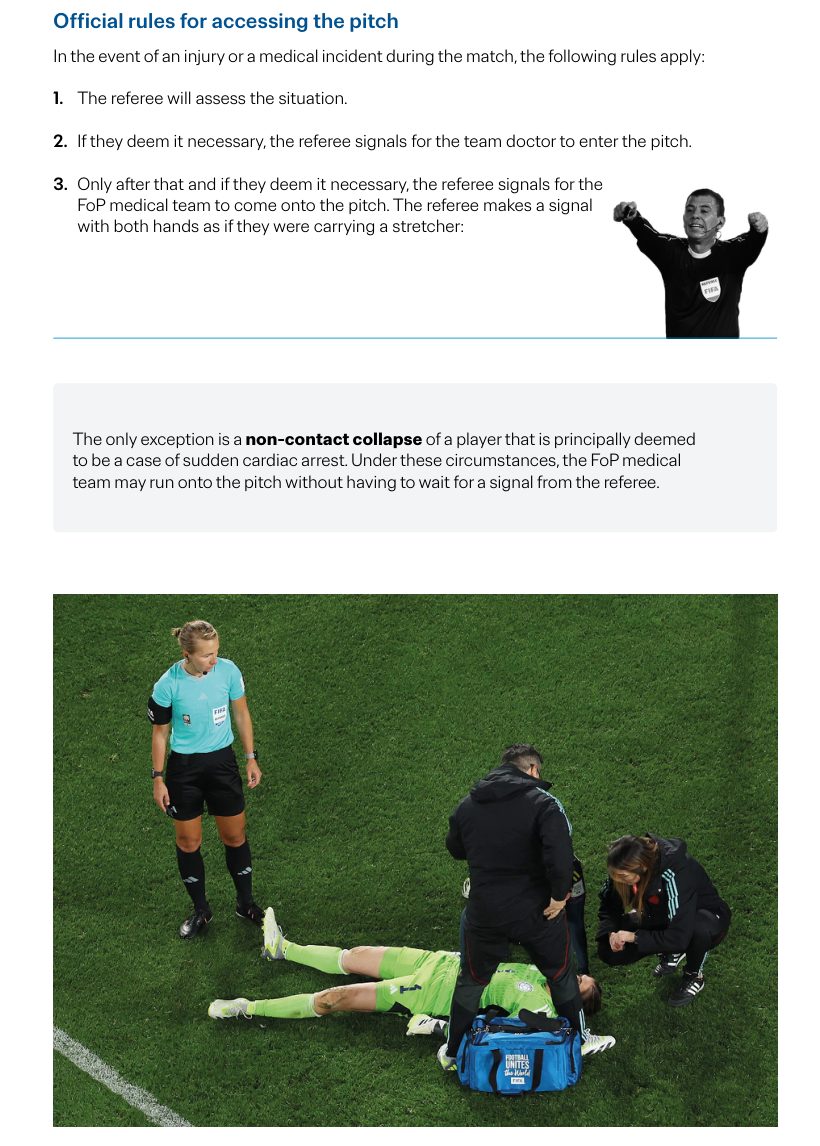
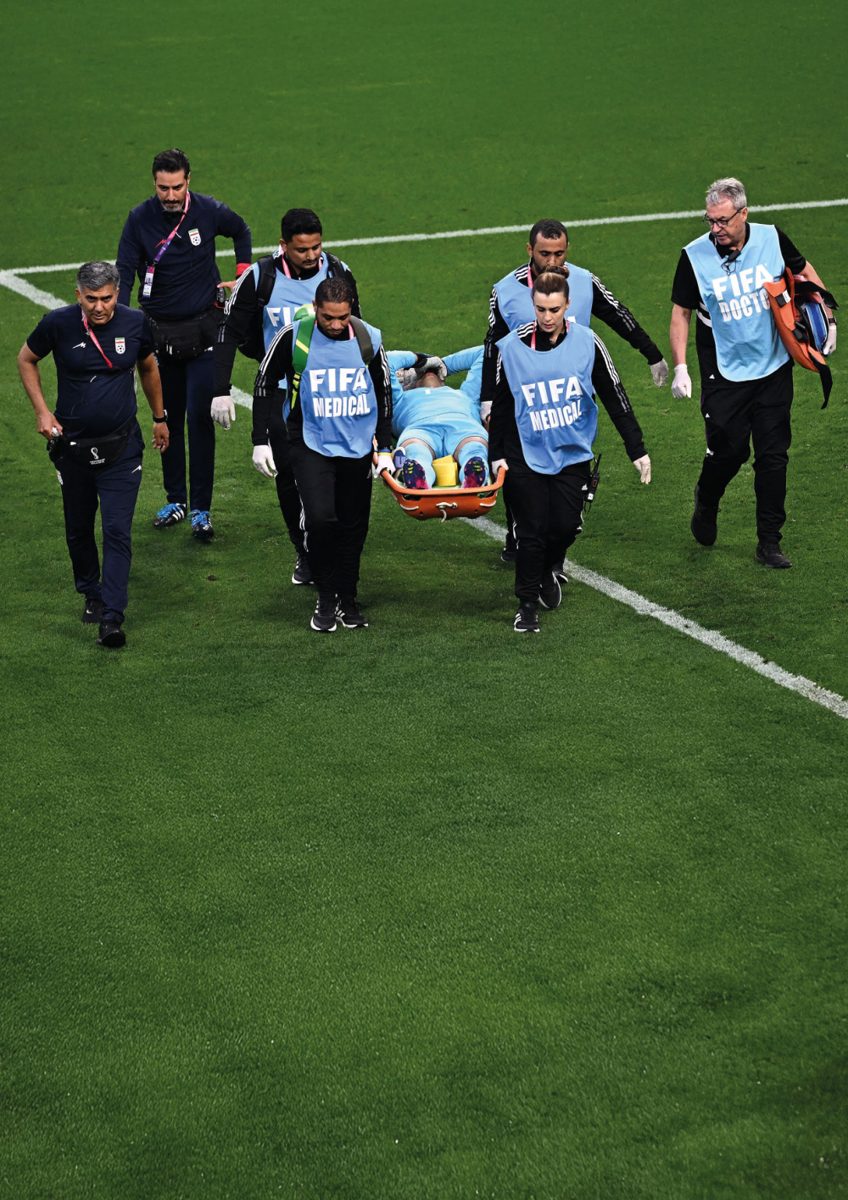
Details are in skill modules 1 to 4.
FIFA POSTERS AND FACTSHEETS
Tap a picture to open it full size and zoom in.
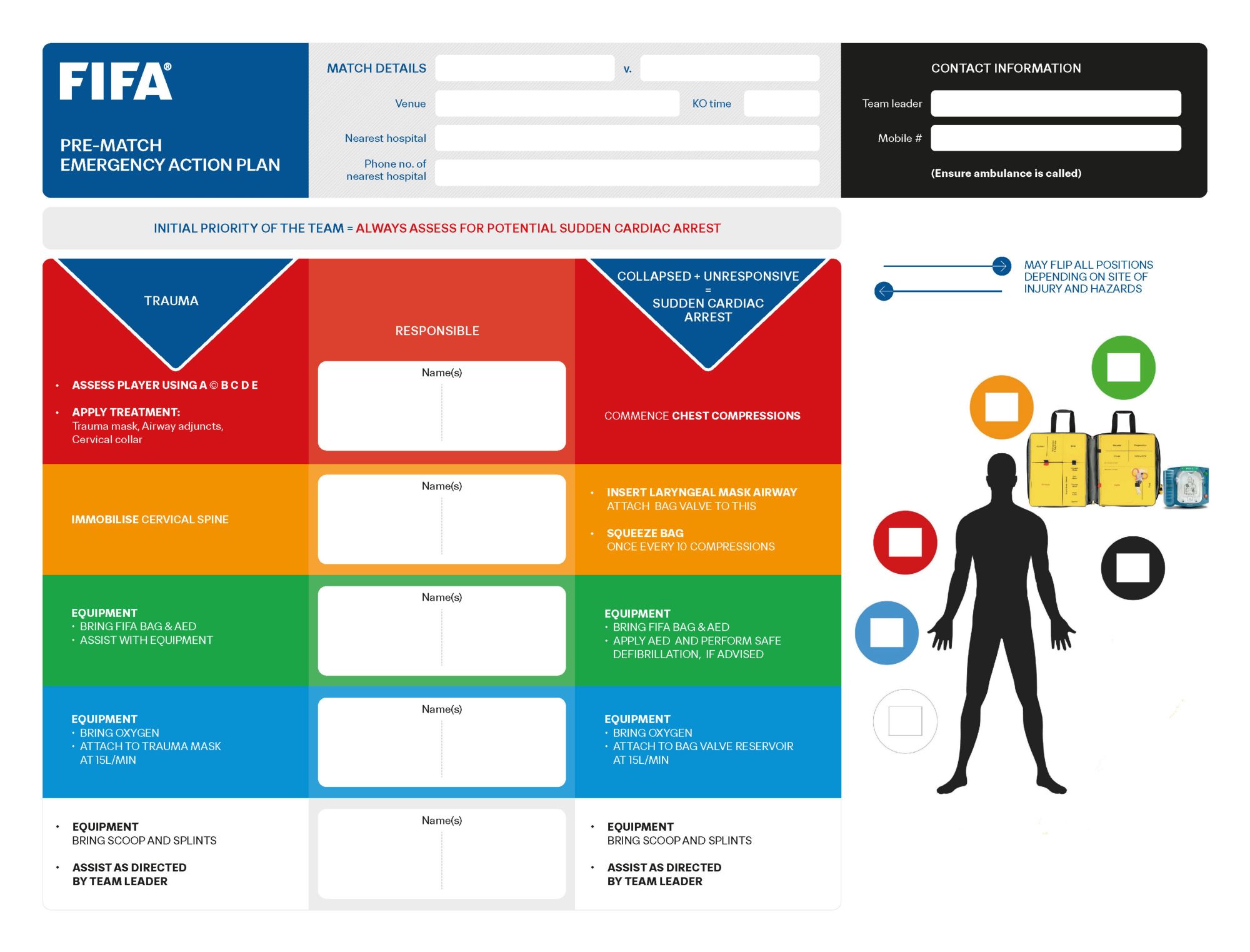 FIFA Pre-Match Emergency Action Plan (PEAP)Fill in before every match: venue, hospital, team leader and a name for each colour.
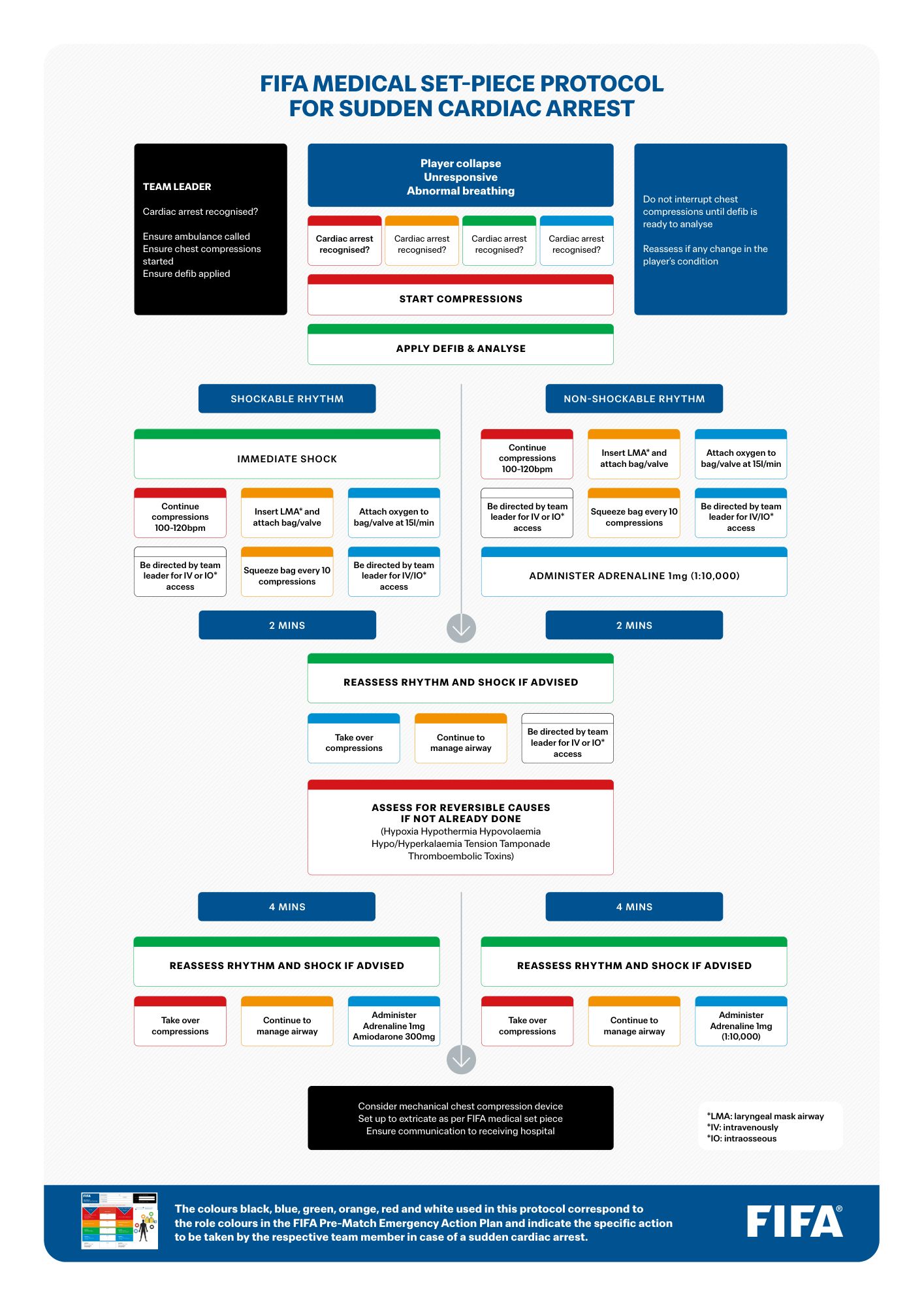 Set-Piece protocol: sudden cardiac arrestEach colour's tasks from collapse to transfer.
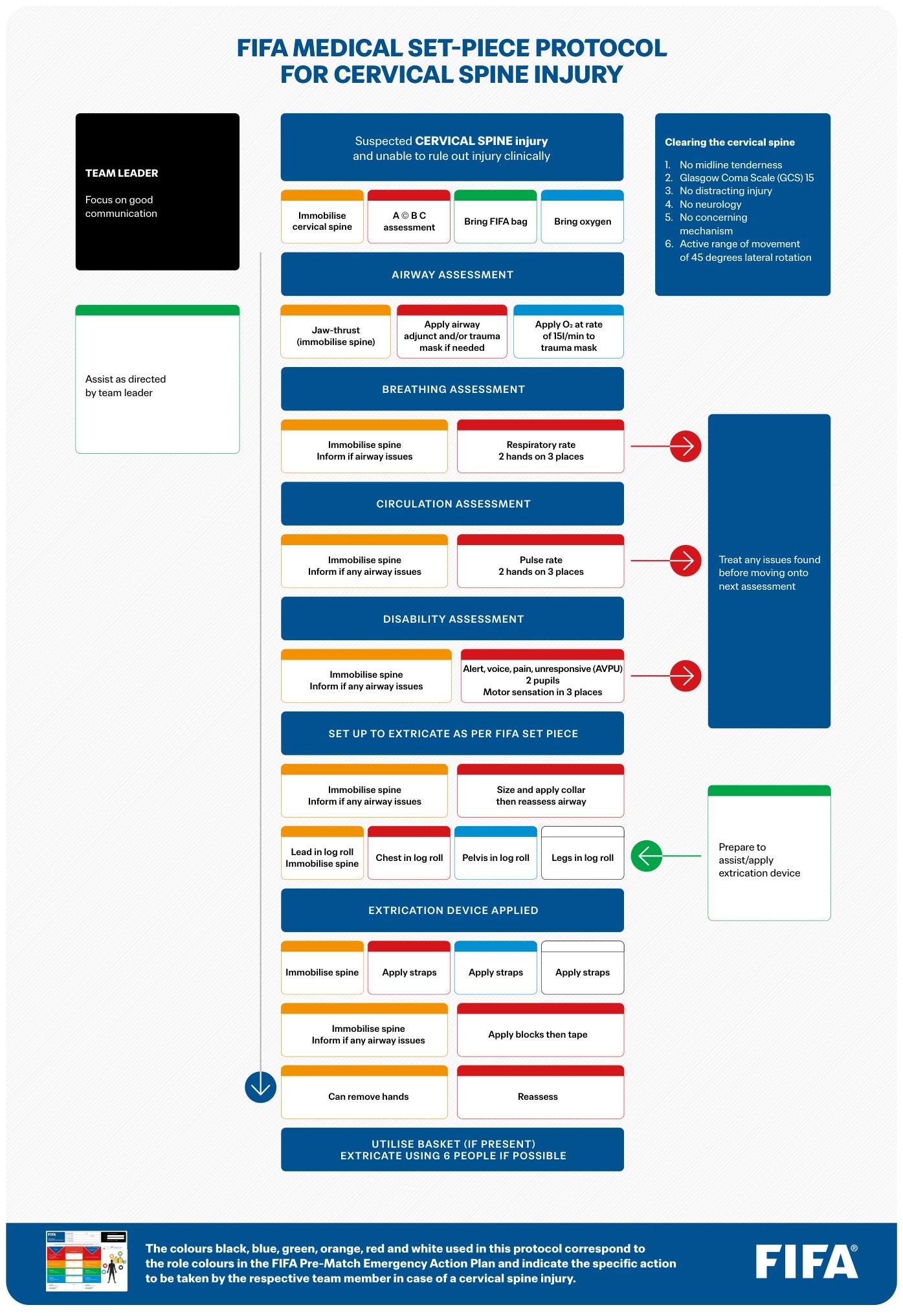 Set-Piece protocol: cervical spine injuryMILS, A–E assessment, collar, blocks, straps and extrication with 6 people.
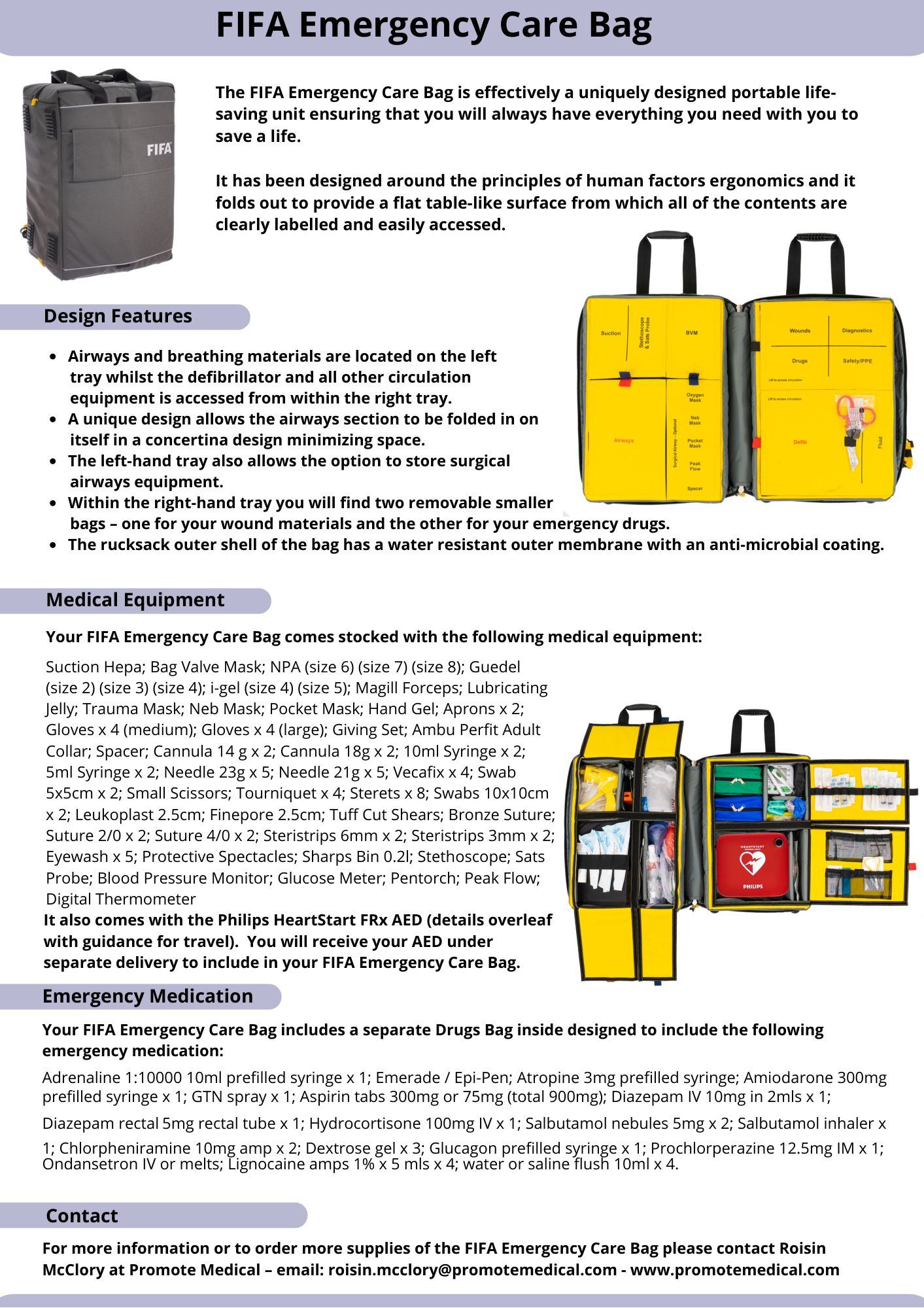 FIFA Emergency Care Bag factsheetDesign, full contents and the emergency drugs pouch.
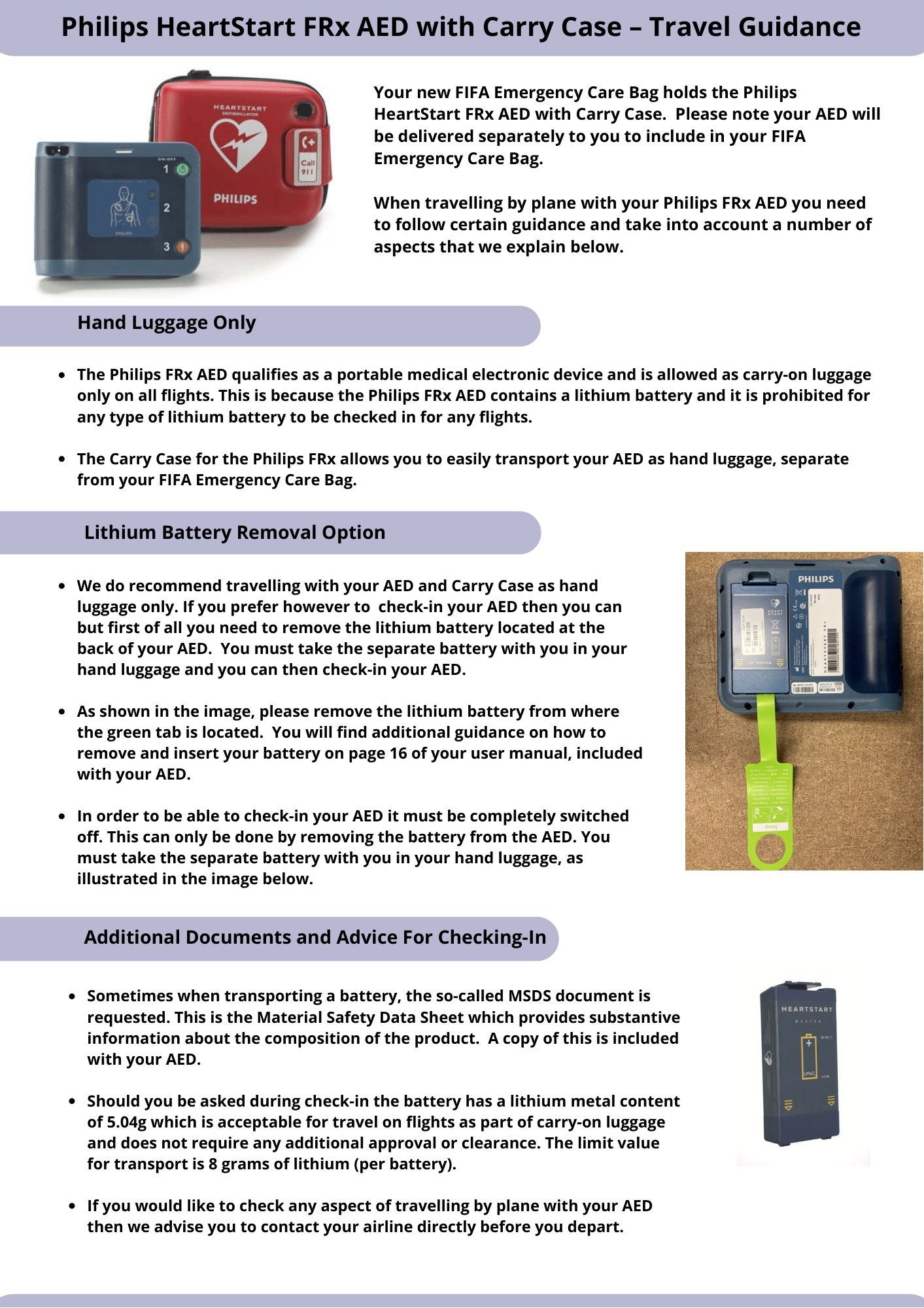 Philips HeartStart FRx — travel guidanceHand luggage only; remove the lithium battery before checking it in.
FIFA EMERGENCY CARE BAG
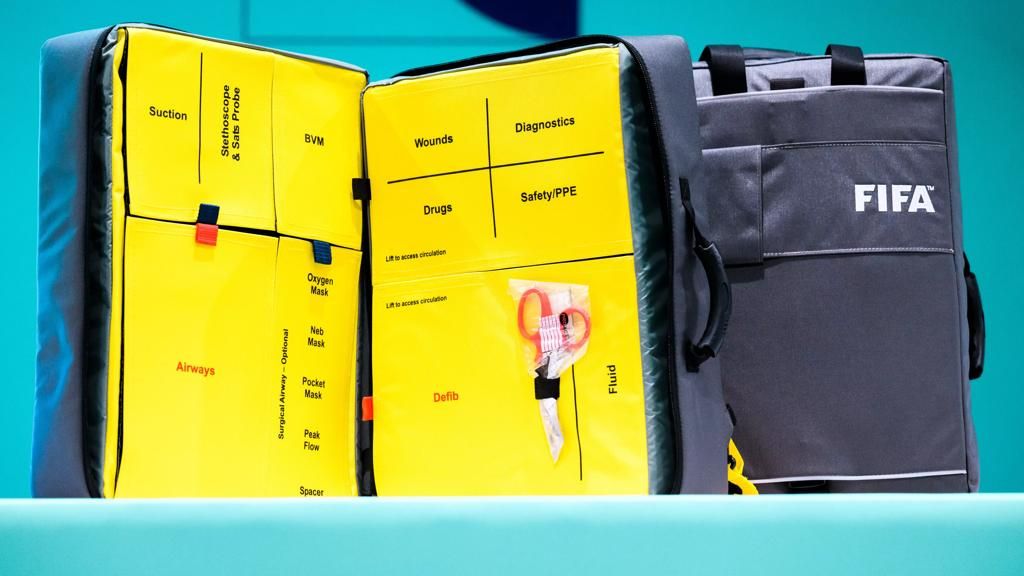
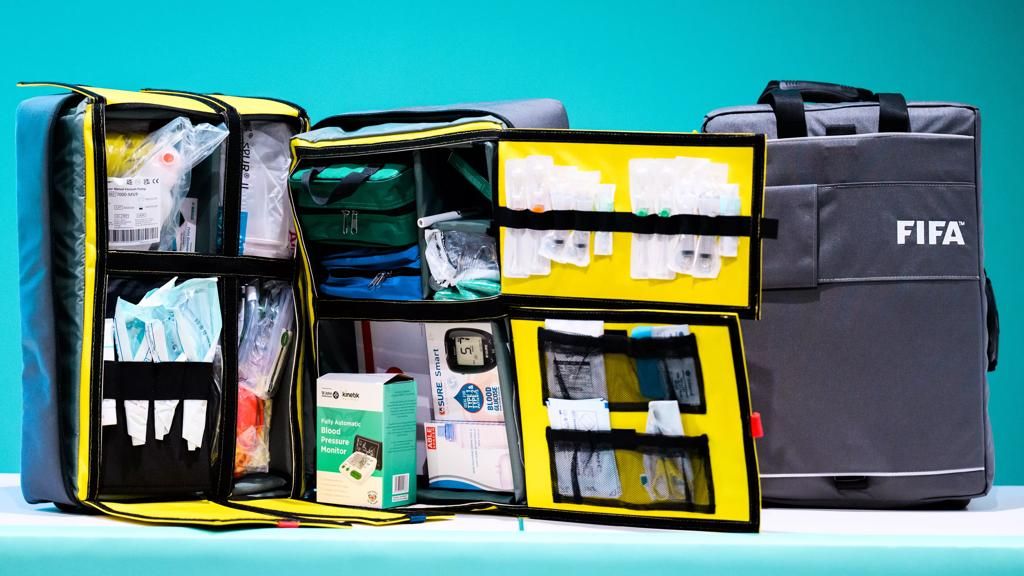
A portable life-saving unit built around human-factors ergonomics: it folds out flat like a table so every clearly labelled item is in reach.
OFFICIAL FIFA DOWNLOADS
- FIFA Emergency Care Manual (PDF, 45 MB)
- FIFA Pre-Match Emergency Action Plan (PEAP)
- Medical Set Piece — Roles within the PEAP (role cards)
- Medical Set Piece — Protocols for on-field interventions (9 MB)
- Medical Set Piece — Sudden cardiac arrest protocol
- Medical Set Piece — Cervical spine injury protocol
- FIFA Emergency Care Bag and AED factsheet
- Set-piece approach for medical teams (2022 paper)
- Simpler means safer: the new Set-Piece toolkit and PEAP (BJSM blog, 2025)
From FIFA's Pitchside emergency care page. Films, posters, photos and documents © FIFA.