
FIFA HEALTH & MEDICAL
Sudden cardiac arrest
Key points from FIFA's official page, with its videos and downloads.
- The heart suddenly stops pumping. It usually comes without warning and can strike anyone — including players who look fit and healthy.
- Knowing CPR and how to use an AED is what makes the difference between life and death.
4 SIGNS OF SCA
Non-contact collapse
A player who goes down without contact with another player, the ball or an obstacle has SCA until proven otherwise.
Unresponsive
No response at all to voice or touch.
Abnormal or absent breathing
Breathing can look normal, even rapid, for about the first 90 seconds; then it becomes abnormal — gasping — before it stops. Normal-looking breathing does not rule out a cardiac arrest, and gasping is not normal breathing.
Brief seizure-like movements
Slow involuntary jerks are part of SCA — treating it as a fit delays resuscitation.
FIFA VIDEOS
FIFA's own films. Tap play — needs a connection.
FIFA's own film of the colour-coded Medical Set Piece: recognition, CPR, AED, airway and the role of each team member on the pitch.
Watch on FIFA's website (opens in a new tab)Why FIFA trains medical teams in pitchside emergency care — player health as the top priority.
Watch on FIFA's website (opens in a new tab)EMERGENCY STEPS
- Go to the player or official immediately — time is critical.
- Check whether they respond.
- Turn them onto their back, taking care of the neck.
- Call the local emergency number if no one else can help.
- Get the AED — it should be at every training session and match.
- While the AED is coming, start hands-only chest compressions and do not stop unless you must.
- Switch the AED on and follow its voice prompts.
- Keep going until the ambulance team takes over.
Bystander steps vs the medical team
These are FIFA's steps for anyone on the scene (hands-only CPR). The medical team follows the colour-role drill: 30:2 with a face mask until an i-gel is in, then continuous compressions with a breath every 10th compression.
FIFA INFOGRAPHICS
Tap a picture to open it full size and zoom in.
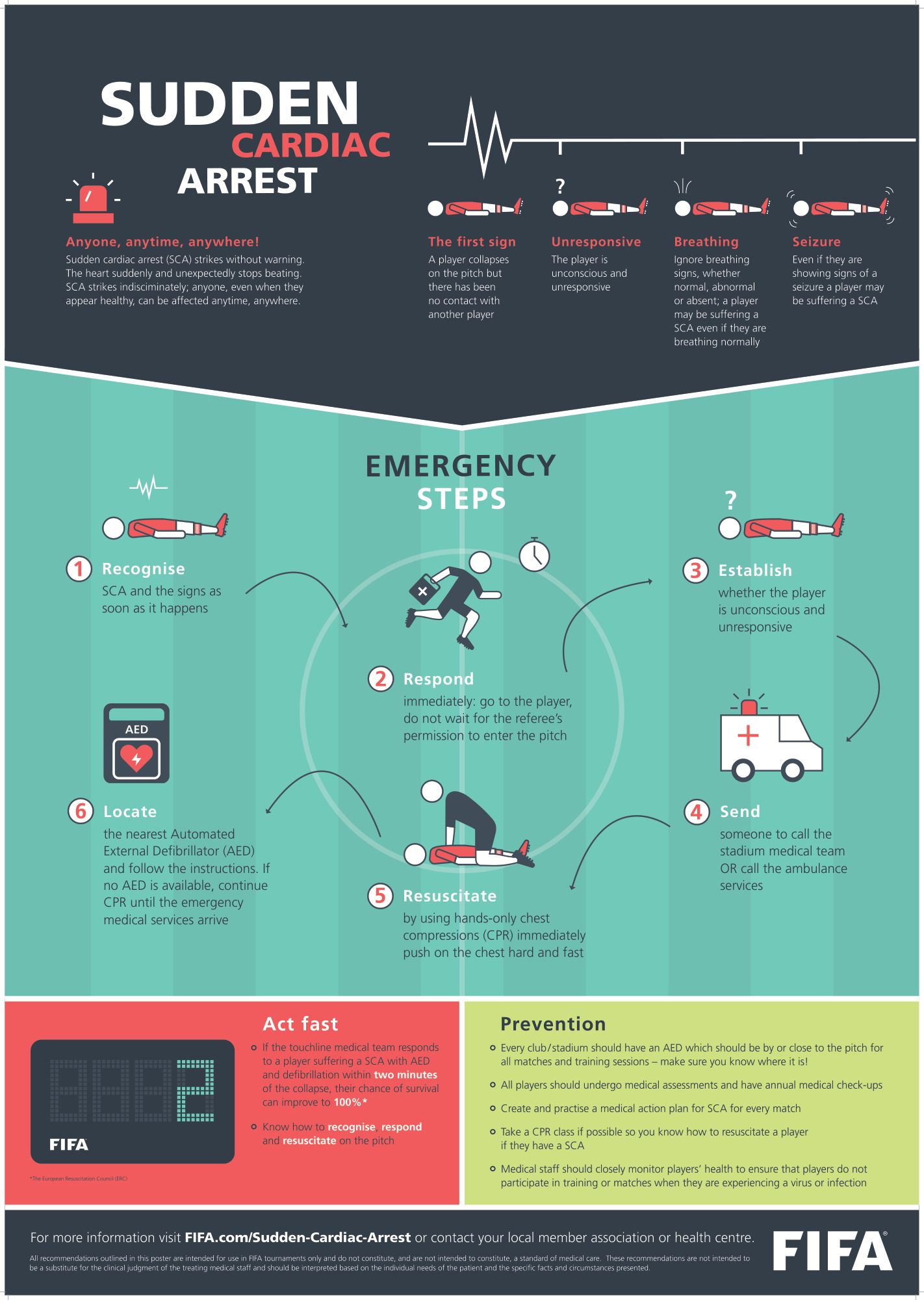 Sudden cardiac arrest – how to helpSigns, the 6 emergency steps, act fast and prevention.
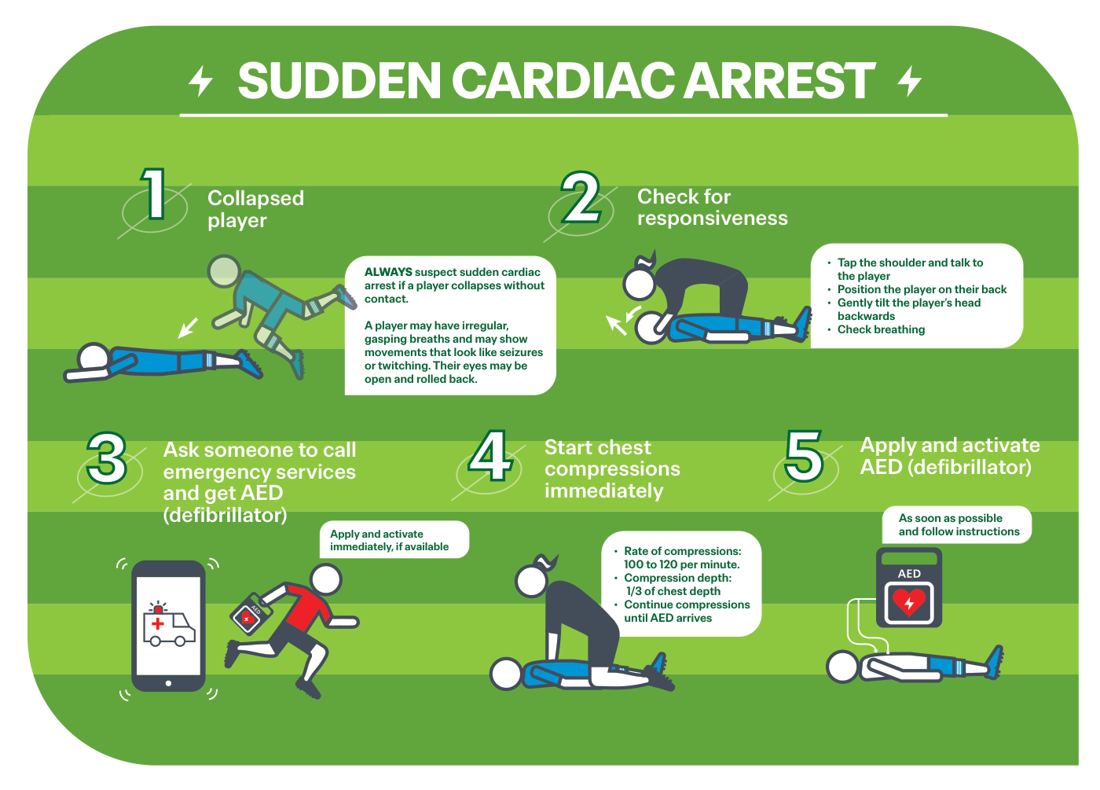 Managing sudden cardiac arrestCollapse → check → call + AED → compressions → apply AED.
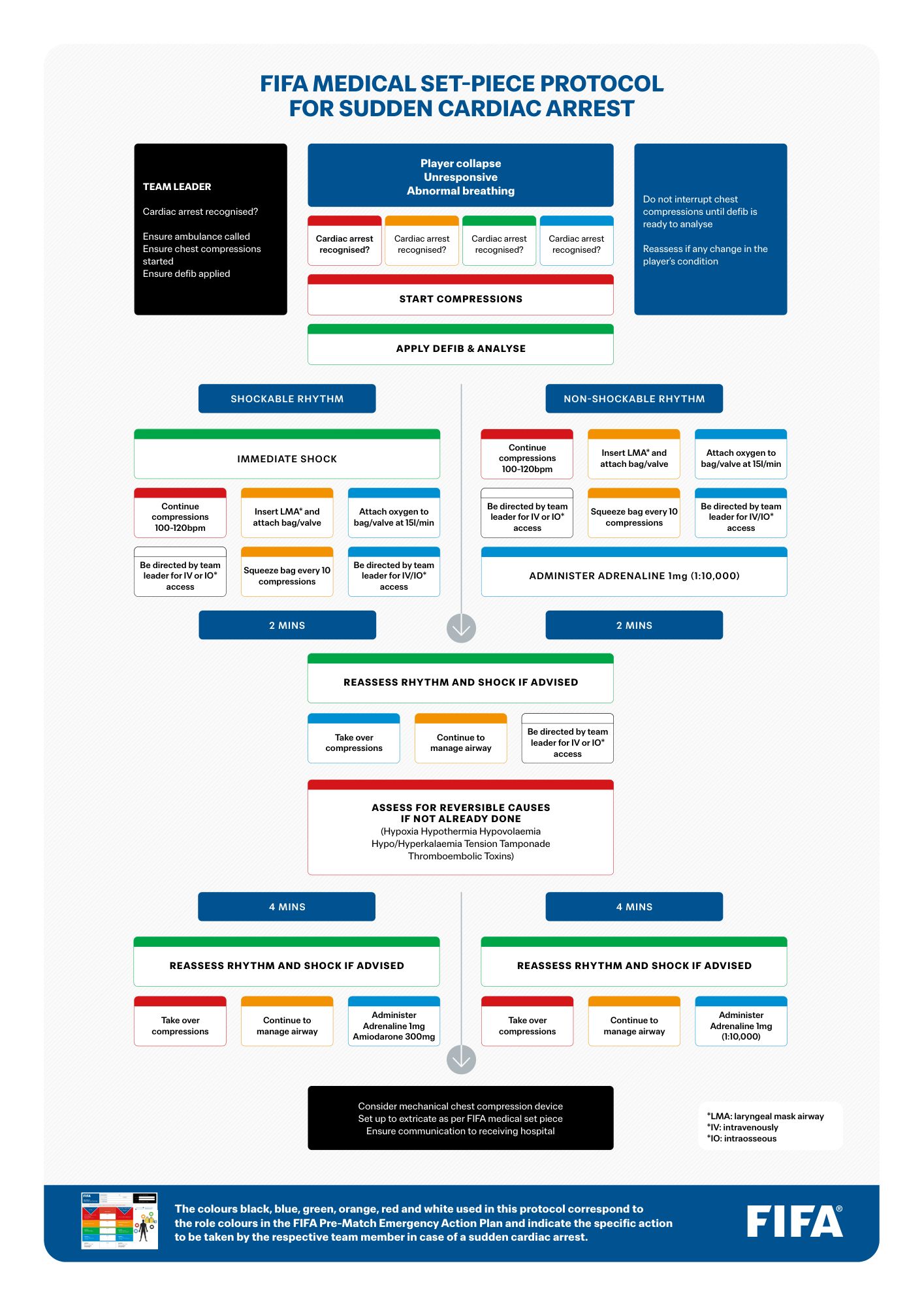 FIFA Medical Set-Piece protocol for SCAColour-coded algorithm for each PEAP role.
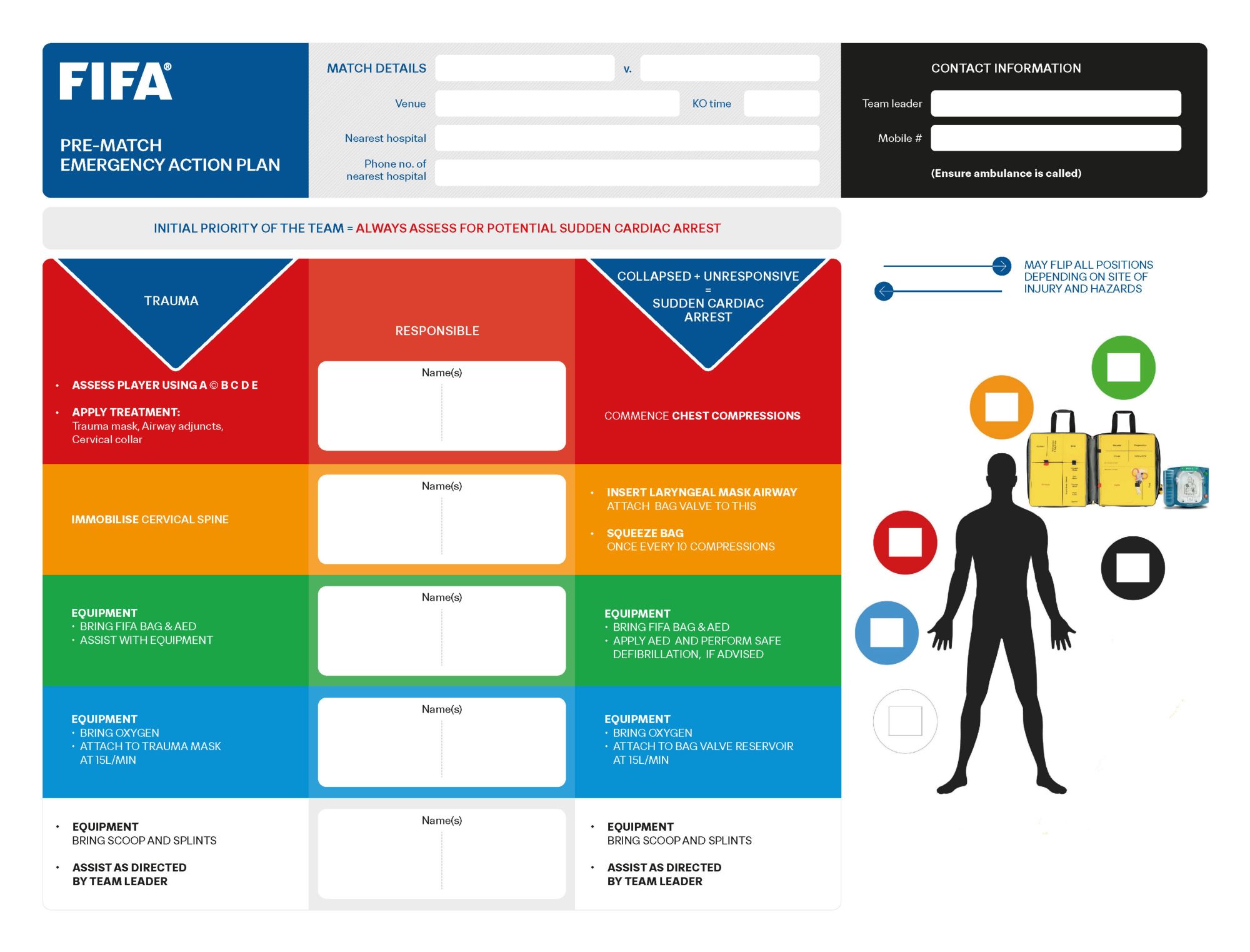 FIFA Pre-Match Emergency Action Plan (PEAP)Fill in before every match: contacts, roles, positions.
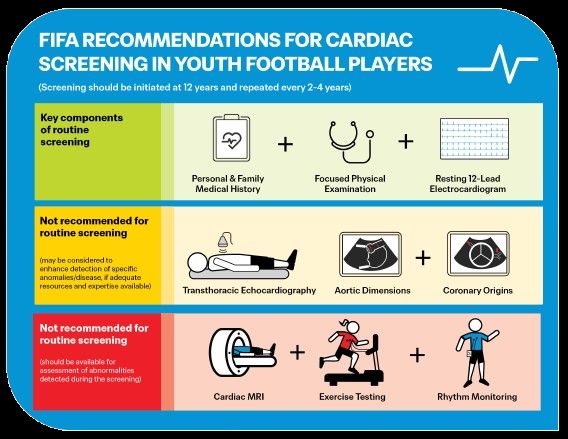 Cardiac screening in youth playersFrom 12 years, repeat every 2–4 years.
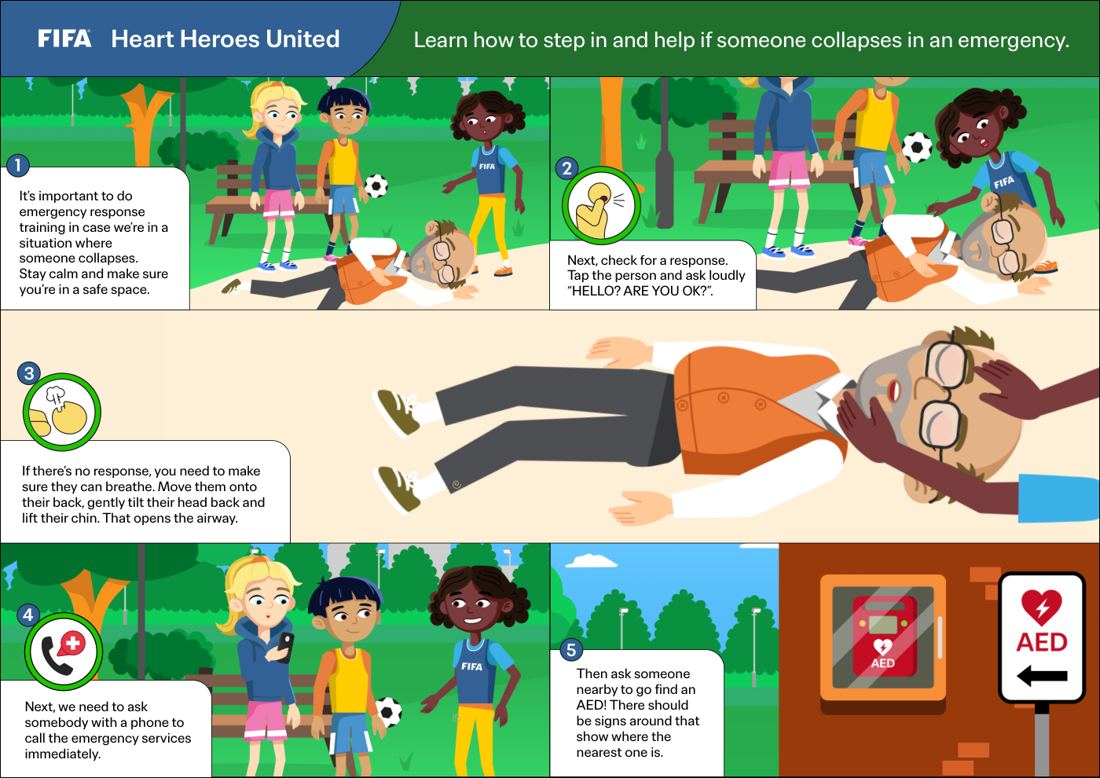 Heart Heroes UnitedFIFA animated series: CPR and AED for children.
WHAT CAUSES SCA
- Inherited heart-muscle diseases or structural heart anomalies.
- A viral illness such as flu combined with hard exercise over roughly 3–5 days, which can inflame the heart muscle.
- Medications, drugs and stimulants — they raise the risk during exercise.
- Rarely: the ball striking the centre of the chest at a vulnerable moment of the heartbeat.
PREVENT AND PREPARE
- An emergency action plan (the FIFA PEAP) for every match and training session, known by all first-aid and medical staff.
- Know how to resuscitate a player on the pitch.
- Have an AED close by — and know exactly where it is.
- CPR and AED training for players, team and match officials and stadium staff, rehearsed regularly.
- Watch players closely during and after a viral illness.
- Medical evaluation and cardiac screening where resources allow.
FIFA Medical Set Piece
FIFA's Medical Set Piece is a rehearsed script: each responder has one clearly defined, colour-coded job (black, blue, green, orange, red, white — the same colours as the PEAP), so everyone stays on task under pressure.
CARDIAC SCREENING
- Cardiac screening is mandatory before FIFA competitions: medical history, examination and an ECG, with further tests if needed.
- Youth players: start at about 12 years and repeat every 2–4 years — personal and family history, focused examination and a resting 12-lead ECG.
- FIFA's screening form asks about symptoms at rest or on exercise — chest pain or tightness, sudden palpitations, unexplained breathlessness, and unexplained collapse, seizure or fainting — and about medication and known heart disease.
- Family history counts if it happened before the age of 50: sudden or unexplained death or cardiac arrest, unexplained collapse, inherited heart disease, a sport restriction for a heart condition, or a cardiac procedure such as an implanted defibrillator.
- Examination: blood pressure in both arms and heart rate after five minutes lying at rest, heart murmurs, and features of Marfan syndrome.
- Resting 12-lead ECG, lying down after at least five minutes of quiet rest, read against the international criteria for athletes. If in any doubt, ask a cardiologist experienced with athletes.
- Echocardiography is an optional extra, only where high-quality imaging and expert interpretation are available; it helps to detect coronary artery anomalies and aortic disease.
- No screening programme gives complete protection: early CPR, a prompt AED and an emergency plan give the best chance of survival.
OFFICIAL FIFA DOWNLOADS
- Sudden cardiac arrest – how to helpPDF
- Managing sudden cardiac arrest (infographic)PDF
- FIFA Pre-Match Emergency Action Plan (PEAP)PDF
- FIFA Medical Set Piece – emergency protocol for SCAPDF
- Set-piece approach for medical teams (2022 paper)PDF
- Cardiac screening assessmentPDF
- Cardiac screening for youth players (infographic)Image
- Youth cardiac screening – consensus statementPDF
- Heart Heroes United (infographic, 13 MB)PDF
READ MORE
Simpler means safer: the new FIFA Medical Set-Piece toolkit and PEAP (BJSM blog, 2025)FIFA pitchside emergency careSummary of FIFA's Sudden cardiac arrest page. Infographics, films and documents © FIFA; the originals are on FIFA's website.